

A product update is not just a list of changes, it is a learning shortcut for busy customers. This guide shows how to announce announcements, improvements, and new features in a way that reduces confusion, accelerates adoption, and keeps trust intact.
Most product updates fail for a simple reason: they assume customers have time to decode them. In reality, users open an update message while juggling work, tabs, and notifications, and they only care about one thing: what do I do differently now? If your update forces them to read twice, search docs, or ask support, you did not really ship the update. You shipped the burden.
A strong product update functions like a brief. It compresses the change into a quick mental model: what changed, why it changed, what it unlocks, and what the user should do next. That structure works whether you are announcing a new capability, improving performance, or tweaking an interface. It also scales across channels, from in-app banners to WhatsApp messages, from release notes to customer success emails.
Below is a practical way to write product updates that people actually understand and act on, with examples and a workflow you can run every release cycle. You will also see where automation platforms like Staffono.ai can reduce the operational overhead of communicating changes across multiple messaging channels while keeping the tone consistent and human.
Users do not wake up hoping to learn your roadmap. They want to complete a task. So every update should be anchored to a decision the user can make quickly. Examples:
When you write from the decision backwards, clarity improves automatically. Instead of “We redesigned the dashboard,” you get “If you review weekly performance, the new dashboard makes trends easier to spot and reduces clicks.” The change becomes meaningful, not just new.
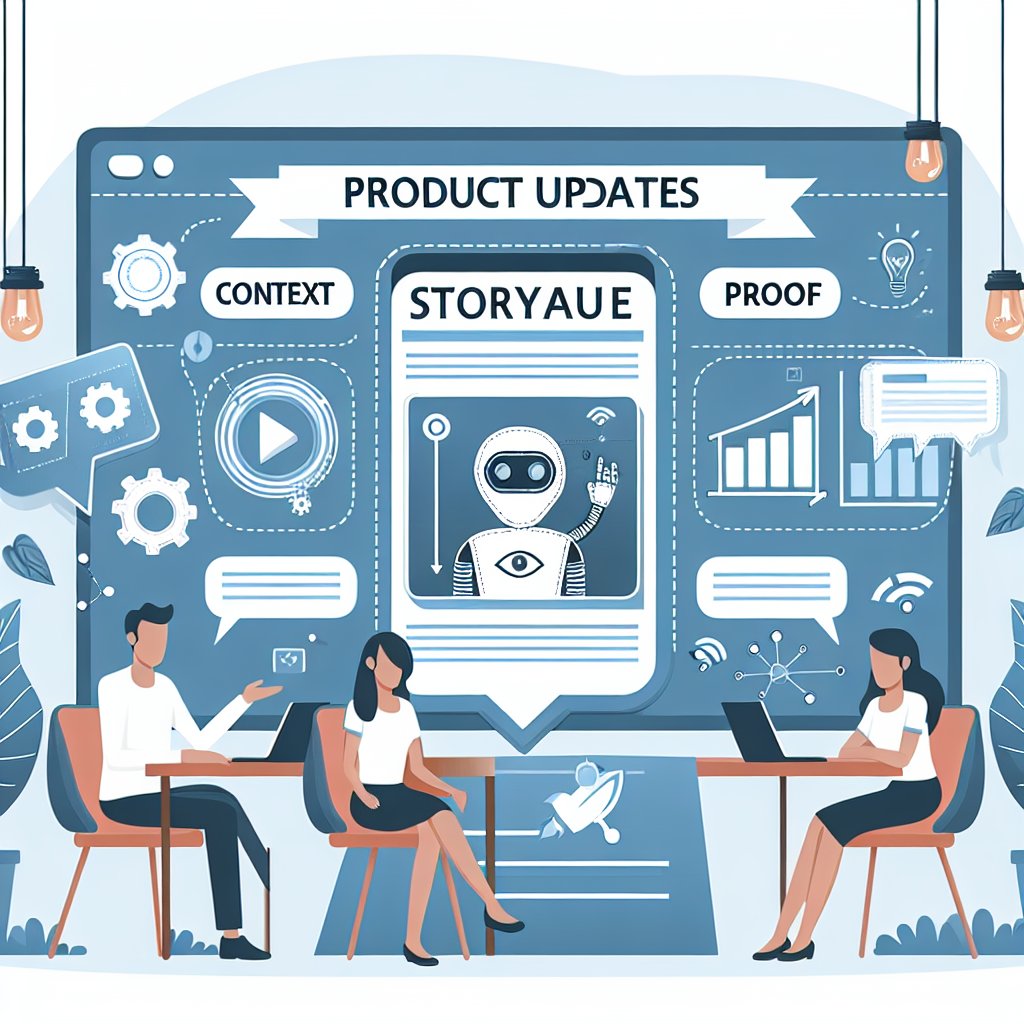
Use a repeatable structure so customers learn how to scan your updates. A consistent pattern builds confidence because people know where to look for what matters. This template works well:
Notice what is missing: internal milestones, team names, and vague claims like “better user experience.” Customers interpret “better” as “different,” and different feels risky unless you explain the safety rails.
Improvements are often the hardest to communicate because they are not as exciting as new features, but they can be more valuable. The trick is to describe the practical impact using observable outcomes.
What changed: Reports now load faster, especially for accounts with large datasets.
Why it changed: Slow load times interrupted weekly reviews and caused timeouts during peak hours.
What to do now: No action required. If you previously scheduled exports overnight, you can try running them during business hours.
Proof: Average report load time dropped from 9.2 seconds to 2.8 seconds in our production benchmarks.
This works because it does not ask the user to “feel” an improvement. It tells them what they can now do differently.
New features create choice. Choice creates cognitive load. To reduce that, launch with a narrow “best first use case” rather than a long list of possibilities. Then, provide a path to learn more for power users.
What changed: You can now create auto-replies based on message intent (pricing, availability, booking, refund).
Why it changed: Teams were spending time answering the same questions across WhatsApp, Instagram, and web chat.
What to do now: Start with one intent, for example “availability,” and connect it to your booking link.
Who it affects: Admins and managers who configure messaging workflows.
Proof: Early users reduced first-response time from hours to under one minute on peak days.
This is also where a platform like Staffono.ai fits naturally. If your product touches messaging, lead capture, or bookings, your update should show how the new capability changes the real conversation. Staffono.ai’s 24/7 AI employees are designed around those moments: they answer, qualify, and route customers across WhatsApp, Instagram, Telegram, Facebook Messenger, and web chat, so the feature is not just “available,” it is adopted in daily operations.
Customers trust updates when you acknowledge constraints. If something changed to improve security, say what risk you reduced. If you removed a setting, explain the confusion it caused and the replacement path. You do not need to overshare, but you do need to be specific.
Good “why” statements sound like:
Poor “why” statements sound like:
The goal is not marketing. The goal is reducing uncertainty.
One reason updates feel noisy is that teams broadcast everything everywhere. Instead, segment by urgency and impact:
If your customers prefer conversational channels, automation can help you deliver the right update to the right user without creating manual work. With Staffono.ai, businesses can set up AI employees to proactively send update snippets, answer follow-up questions instantly, and route edge cases to a human team member, all while keeping messaging consistent across channels.
Every update triggers predictable questions. Your job is to answer them before they are asked. Include a small FAQ block inside the update or link to it.
Actionable tip: look at the last three launches and list the first five support tickets that appeared. That list becomes your default FAQ for the next announcement.
If you cannot measure adoption, you cannot tell whether your announcement worked. Pick a single primary action per update. Examples:
Then instrument it and report it internally. Your product update process improves when it is treated like a loop: message, behavior, feedback, iteration.
To operationalize this, run a short “update brief” workflow for each change set:
If you operate across multiple messaging channels, consider automating distribution and Q and A. For example, Staffono can send a short WhatsApp update to customers who opted in, answer “Where did the button go?” immediately, and book a quick help call for accounts that need hands-on guidance. That turns an update from a broadcast into a managed transition.
Your customers do not need perfect prose. They need a clear next step and the confidence that you anticipated their concerns. When you treat updates as learning briefs, you reduce friction, protect trust, and speed up adoption even when the product evolves quickly.
If you want your product updates to land consistently across WhatsApp, Instagram, Telegram, Facebook Messenger, and web chat, and you want customers to get immediate answers when they ask follow-up questions, Staffono.ai can help. Its AI employees work 24/7 to deliver update messaging, handle common questions, qualify requests, and keep your team focused on building while users stay informed and confident.