

Product updates are not just a list of new features, they are a narrative about what you learned, what you fixed, and what customers can do next. This guide shows how to write announcements that clarify what changed and why, reduce confusion, and drive faster adoption across every channel.
Most product updates fail for a simple reason: they read like a warehouse inventory. New toggle, improved performance, bug fix. Users skim, miss what matters, and then support gets the same questions for weeks. The problem is not that customers dislike change. The problem is that they cannot quickly connect the change to their daily workflow, risk level, and expected outcome.
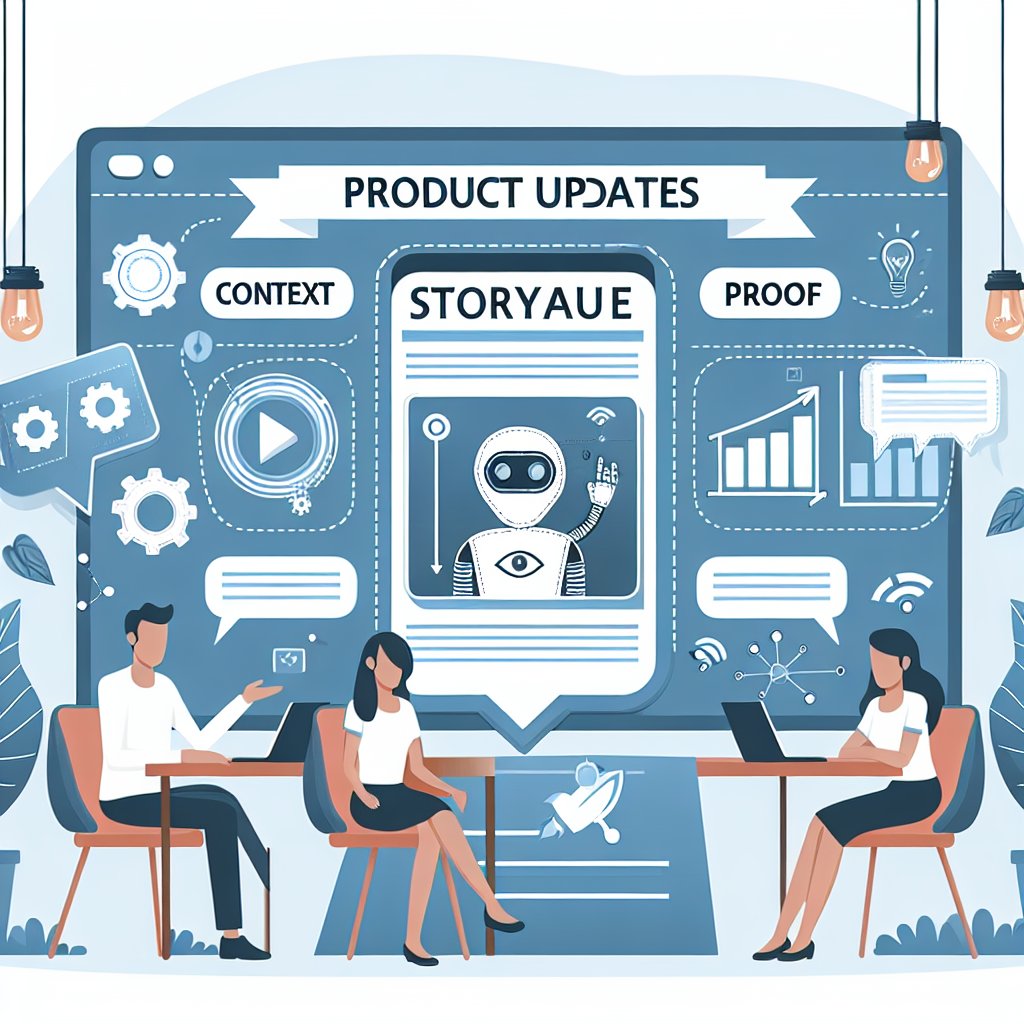
A strong product update is closer to a short story than a changelog. It has a trigger (what you observed), a decision (what you changed), and a payoff (what users can now do). When you consistently tell that story, customers trust your direction, teams align faster, and adoption rises with less hand-holding.
Users do not experience your product as features. They experience it as a sequence of actions: open, search, message, approve, book, pay, report. When you announce an update, the real question in their head is, “Does this alter my sequence?” If yes, they need guidance. If no, they need reassurance.
“Why it changed” is what gives the update meaning. It also prevents the most expensive failure mode: users inventing their own explanation. When people guess, they often assume you optimized for your business at their expense. Clear intent changes the tone from suspicion to partnership.
Use a repeatable template that fits in an email, a help center article, or an in-app message. The goal is not to write more, but to write what answers the right questions quickly.
Open with a recognizable moment, not an internal project name. For example: “When you are replying to leads on WhatsApp and Instagram at the same time, it is easy to miss a high-intent question.” This immediately anchors the update in a real workflow.
Triggers can be customer feedback, data patterns, or operational constraints. The best triggers are specific. “We saw that 18 percent of booking conversations stalled after the customer asked about availability” is more credible than “We improved the booking flow.”
Describe the outcome, then the mechanism. Outcome-first helps users decide if they should keep reading. Example: “You can now confirm appointments in fewer steps. We added a single confirmation screen with a summary of time, location, and policy.”
Be explicit about eligibility and the new default behavior. Users hate surprises more than they hate change. Include quick instructions or a short checklist. If the update is optional, say where the setting lives and why someone might turn it on.
Trust increases when you mention boundaries: what the feature does not do, and what happens if something goes wrong. If you have a rollback, a feature flag, or a fallback workflow, say it. This is especially important for workflow tools, payments, and messaging automation.
Even if you do not have perfect data yet, you can offer directional outcomes: faster response time, fewer clicks, lower error rate, more completed bookings. Numbers are optional, clarity is not.
Scenario: “Customers ask the same questions before they book.”
Trigger: “We noticed repeated questions about pricing, availability, and return policies across chat.”
Change: “We launched a new FAQ automation block that inserts verified answers into conversations.”
How to use: “Add up to 20 FAQs, tag each by topic, and choose which channels it appears on.”
Edge case: “If the AI is not confident, it asks a clarifying question or routes to a human.”
Payoff: “Fewer repetitive replies, faster bookings, and more consistent answers across teams.”
This is also where platforms like Staffono.ai fit naturally. If your product touches messaging, your release should include how the feature behaves in real conversations. Staffono’s AI employees can demonstrate the new behavior immediately across WhatsApp, Instagram, Telegram, Facebook Messenger, and web chat, so the announcement is not just words. Users feel the change in the first interaction.
Scenario: “Sales teams lose time re-asking questions already answered in chat.”
Trigger: “We saw that lead qualification data was scattered across messages and notes.”
Change: “Conversation summaries now capture intent, budget range, and timeline automatically.”
How to use: “Open any chat and view the summary panel, then export to your CRM.”
Edge case: “If a customer changes their mind, the summary updates after the next message.”
Payoff: “Shorter handoffs, fewer follow-up questions, and more accurate pipelines.”
If you run customer communication at scale, this improvement becomes even more valuable when paired with automation. With Staffono.ai, the AI employee can both capture the qualification signals in real time and push structured data into your systems, making the improvement measurable instead of theoretical.
Bug fixes are tricky because teams either overshare technical detail or hide the issue. The best approach is calm, specific, and user-centered.
Scenario: “A customer submits a form, but the confirmation message never arrives.”
Trigger: “A timing issue caused confirmations to fail when traffic spiked.”
Change: “We added a retry mechanism and monitoring alerts.”
Who is affected: “This impacted a small percentage of submissions during peak hours.”
What users should do: “Nothing. If you notice a missing confirmation, the system now re-sends automatically.”
Payoff: “Higher reliability, fewer missed bookings, and clearer status visibility.”
Even a great update fails if it is delivered in the wrong place. Match the channel to the urgency and the behavior change.
If your customers already communicate with you through messaging, consider delivering updates there as well. Staffono.ai can send a brief, personalized update to customers in the channels they already use, answer follow-up questions instantly, and route complex cases to your team. That turns an announcement into an interactive onboarding moment instead of a one-way broadcast.
Most audiences include at least three perspectives: the daily user, the admin, and the executive buyer. You do not need three separate posts, but you should include:
For every meaningful update, define one adoption metric and one outcome metric. Adoption might be “percentage of accounts enabling the new setting.” Outcome might be “reduction in time-to-first-response” or “increase in booking completion rate.” Mentioning these in the update signals seriousness and helps customers evaluate the change.
Do not hide feedback behind a generic form. Add one question: “Did this change help you?” with two options and a comment field. If you can, collect feedback inside the workflow, right after the user experiences the change.
When your updates consistently explain the reason behind the change, customers start reading them differently. They stop looking for gotchas and start looking for opportunities. Internally, the same clarity reduces debate, because teams can trace each update back to a customer problem and a measurable outcome.
If you want your product updates to land as clearly in conversations as they do in documentation, consider making them interactive. With Staffono.ai, you can deploy AI employees that announce relevant changes through WhatsApp, Instagram, Telegram, Facebook Messenger, and web chat, answer “how do I use this?” questions instantly, and guide users to the right setup steps. When customers understand what changed and why in the exact moment they need it, adoption becomes the default, not the exception.