

Most product updates fail for one simple reason: the team speaks in implementation, while customers think in jobs, outcomes, and risk. This guide shows how to translate announcements, improvements, and new features into clear decisions customers can act on, with examples you can copy and a rollout checklist you can run every release.
Product updates are not just a record of what shipped. They are a translation exercise between two realities: how your team built something and how customers decide to use it. When updates are written like internal commit messages, users miss the point, adoption stays flat, and support sees a spike in “what changed?” tickets.
A strong update announcement answers three questions in the customer’s language: what changed, why it changed, and what to do next. The trick is that “why” is rarely the technical why. Customers want the operational why: what problem gets easier, what risk gets lower, what metric improves, and what new capability becomes reliable.
Below is a practical framework you can use for announcements, improvements, and new features, plus examples, templates, and a rollout plan. If your product touches customer communication or sales, you will also see where automation platforms like Staffono.ai can help you deliver updates consistently across WhatsApp, Instagram, Telegram, Facebook Messenger, and web chat, without turning your team into a 24-7 notification desk.
People ignore updates when they cannot quickly map the change to their day-to-day workflow. Common failure modes include:
To fix this, treat product updates as a translation layer: from build details to customer decisions.
Use this structure for every announcement, regardless of size. It works for brand-new features, incremental improvements, and behavior changes.
Before writing the update, name the job the customer is trying to do. Examples:
Then write the update as a change to that job, not a change to your codebase.
Customers care about outcomes like speed, accuracy, reliability, cost, and compliance. Your “why” should land in those buckets. For instance:
Every update should include a single, explicit next step. Examples:
This is the difference between “nice to know” and “actually adopted.”
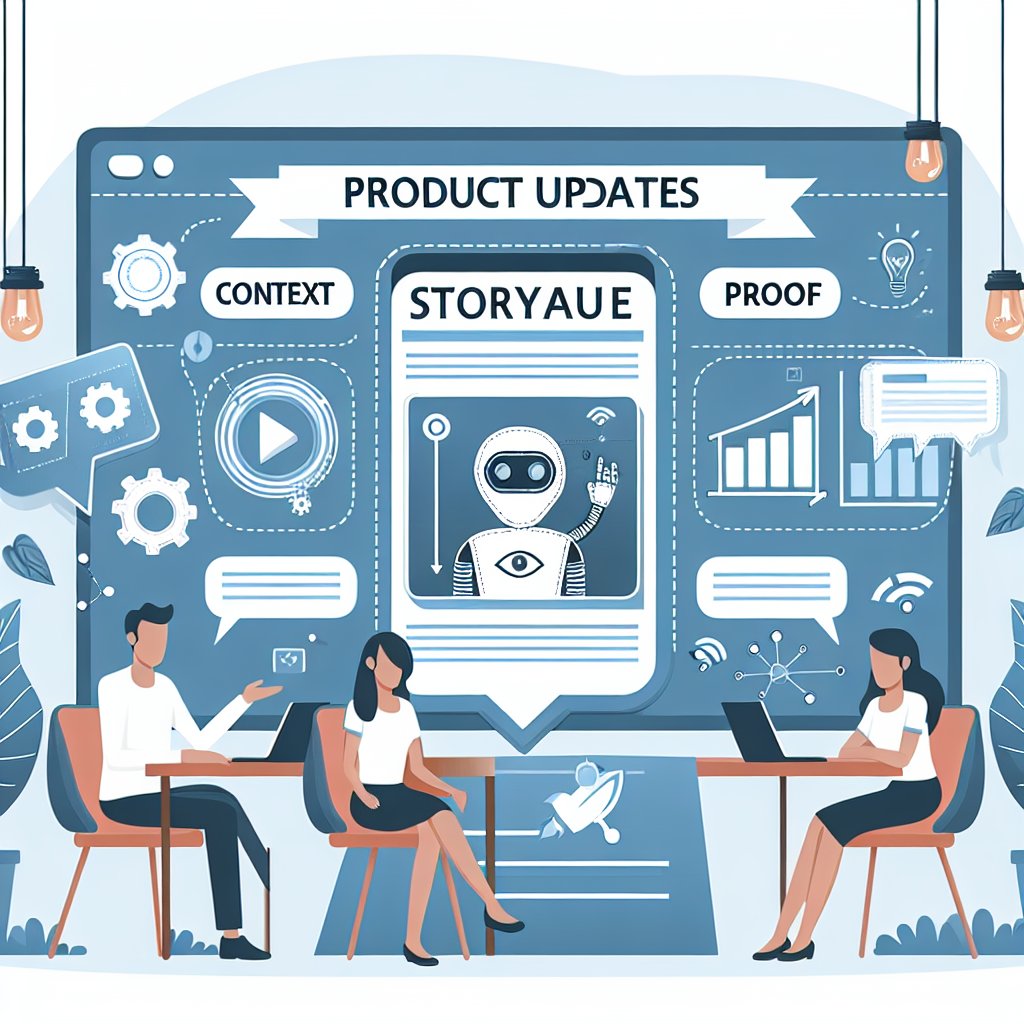
New features need clarity on who it is for, what problem it solves, and how fast someone can see value. A good pattern is: outcome first, setup second, proof last.
Example announcement (new feature):
“You can now auto-qualify inbound leads with a short chat and route them to the right pipeline stage. This change reduces time-to-first-response and helps sales teams focus on high-intent conversations. To get started, enable Lead Qualification, choose 3 to 5 questions, and set routing rules by product line.”
Where possible, include a tiny proof point: “Most teams can launch in under 30 minutes” or “You will see the new stage in your dashboard immediately.”
If your customers communicate across messengers, mention how they can operationalize it across channels. For example, Staffono.ai can deploy AI employees that handle qualification and routing on WhatsApp, Instagram, Telegram, Facebook Messenger, and web chat, so the “new feature” becomes a real workflow, not a checkbox in a settings page.
Improvements are often the most valuable changes, but they are also the easiest to write badly. Avoid “improved performance” alone. Name the user-visible friction that is gone.
Example announcement (improvement):
“File uploads now finish reliably on slow connections and you can continue working while they process. This reduces failed submissions and prevents duplicate attempts. No action needed, but if you previously avoided uploads on mobile, try it again.”
Notice how “what changed” is tied to a real scenario: slow connections, mobile usage, and duplicate attempts.
Sometimes you change defaults, remove options, or alter workflows. This is where trust is won or lost. Do not hide the trade-off. Explain it, time-box the transition, and provide a safe path.
Example announcement (behavior change):
“We updated notification defaults so critical alerts are enabled for all admins. This reduces missed time-sensitive events, but it may increase the number of messages you receive. You can adjust the frequency in Notifications, and we added a weekly digest option for teams that prefer fewer pings.”
A simple addition that dramatically improves comprehension is a short “applies to” line.
This reduces noise and builds confidence that you respect the reader’s time.
Even a perfect announcement fails if it is delivered in the wrong place. Most businesses have at least three audiences:
Match the channel to the audience. A long release note in a help center is fine for admins, but operators may need a short message in the same messenger where they already talk to customers.
This is a practical place to use Staffono.ai. With AI employees working 24-7 across messaging channels, you can broadcast a concise update, answer follow-up questions instantly, and route edge cases to a human. That turns “announcement” into “assisted rollout,” especially for customers who never read dashboards or emails.
Headline: Outcome + audience
Body: What changed, why it matters, how to start
Before you announce, make sure the experience matches the promise.
If you use messaging as a primary channel, you can automate much of this. For example, Staffono.ai can send the right version of the update to each segment, handle immediate “how do I set it up?” questions, and book onboarding calls for customers who need help, all without manual triage.
Here are three “before and after” examples you can adapt for your own release communications:
The best product update is not the one with the most details. It is the one that makes the customer confident enough to act. Translate implementation into outcomes, give a clear next step, and deliver the message where people already work.
If you want your updates to reach customers on the channels they actually use, and you want questions answered instantly while your team sleeps, consider using Staffono.ai. With 24-7 AI employees handling communication, bookings, and sales across major messengers and web chat, you can turn every release into a guided rollout that drives real usage, not just views.