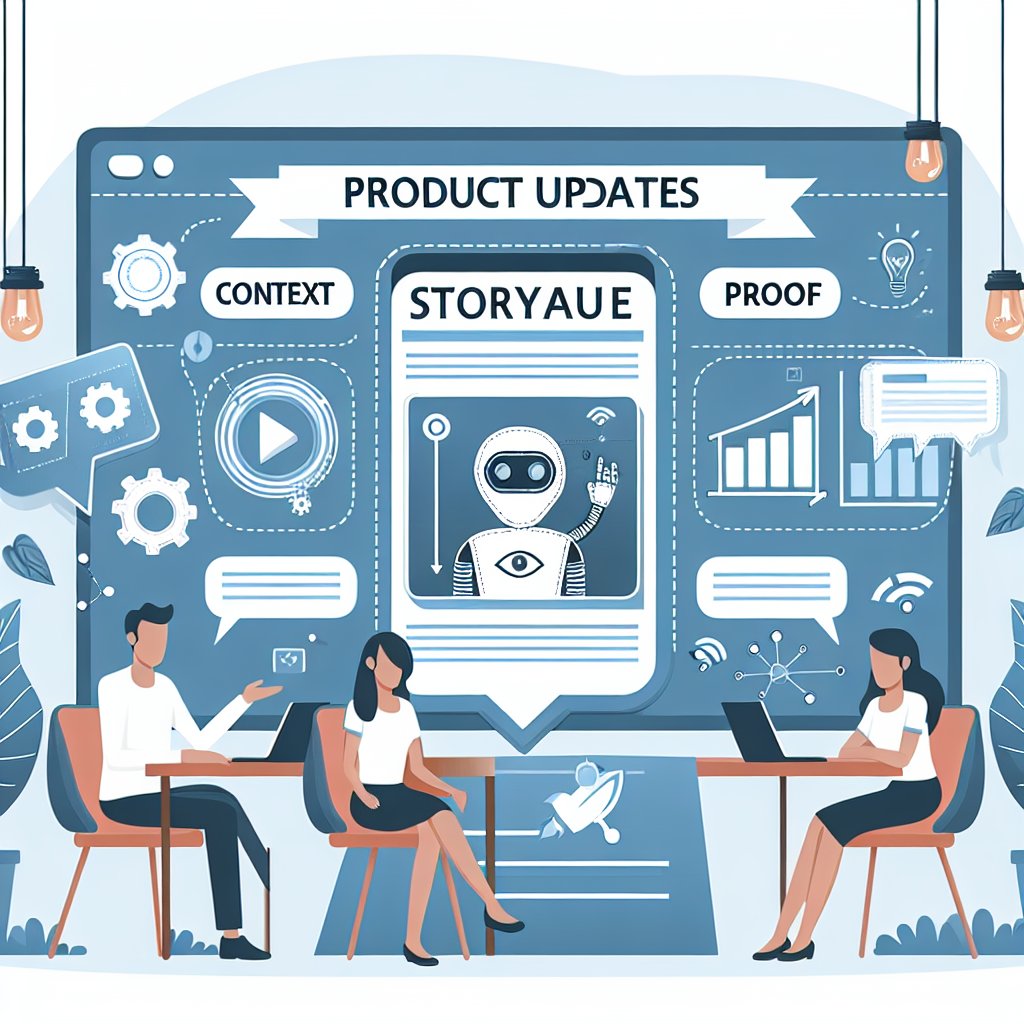


Product updates are not just a list of changes, they are a story about priorities, trade-offs, and outcomes. This guide shows how to announce improvements and new features in a way that reduces confusion, increases adoption, and turns each release into a trust-building moment.
Most product updates fail for a simple reason: teams talk in outputs, while customers listen for outcomes. A release note that says “Improved performance and added new filters” may be technically accurate, but it leaves people asking, “Will this break my workflow?” and “Why should I care?”
The goal of a product update announcement is not to document the work. It is to help users move forward with confidence. That takes context, a clear explanation of what changed and why, and practical guidance for what to do next. When you do it well, announcements become a growth lever: fewer support tickets, faster adoption, more referrals, and a clearer product narrative.
Below is a practical, repeatable way to communicate announcements, improvements, and new features so customers understand them, trust them, and use them.
Even when your team shipped something complex, the customer’s mental model is simple: “I had a problem, and you helped me solve it.” Begin every update by naming the real-world friction that triggered the change.
For example:
This framing makes the “why” obvious. It also prevents the most common failure mode in product updates: listing features without explaining the decision behind them.
Customers rarely read long announcements line by line. They scan, looking for relevance. Structure your update so it can be understood in under a minute.
Describe the change in user language. Mention the affected area, what is different, and who it is for.
Explain the reason with one sentence about the goal and one sentence about the trade-off. Trade-offs build credibility because they show you made intentional choices.
Give a simple action. If no action is needed, explicitly say so. Silence creates anxiety.
Example:
A common mistake is shipping one monolithic announcement that includes everything. Customers do not care whether a change came from “Platform” or “Frontend.” They care whether it affects their day.
Segment updates into groups like:
If you serve multiple industries, add an industry lens. A salon cares about bookings and no-shows; a clinic cares about intake and consent; an e-commerce store cares about order status and returns.
Staffono.ai users often span several messaging channels at once, so segmentation matters even more. An update that affects WhatsApp automation should be instantly recognizable to the person responsible for that channel, without forcing everyone else to read it.
Improvements are hard to sell because they are often invisible. If the change is “faster,” “more reliable,” or “cleaner,” customers may not notice. Make it tangible.
Ways to do this without overloading the announcement:
In messaging-first businesses, even small improvements compound. If your response time drops by 30 seconds across hundreds of conversations, it can change conversion rates and customer satisfaction.
Not every change is breaking technically, but many feel breaking emotionally. A relocated button, a renamed setting, or a new default can create doubt, especially for busy teams.
To reduce disruption:
This is also where proactive messaging automation helps. If your product supports multiple channels, tools like Staffono.ai can send targeted, time-sensitive notifications in WhatsApp, Instagram DMs, Telegram, Facebook Messenger, or web chat, so users receive the right guidance where they already work, not buried in an email thread.
The fastest way to drive adoption is to show how a feature changes a daily task. Use examples that match how customers use your product, not how your team built it.
A new “Appointment Deposit” option is not just a feature. It is a no-show reduction mechanism.
“Better lead routing” should be translated into a scenario:
If you use Staffono.ai, this kind of routing can be handled by AI employees that work 24/7, qualifying leads, answering FAQs, and booking appointments across channels while keeping the handoff to humans clean when needed.
Customers discover updates in different ways. Some read email. Some notice changes only when something looks different. Some rely on in-app notifications.
Distribute your update across:
The key is consistency: the same naming, the same benefits, the same next steps. Conflicting explanations create support load.
A release is successful only if users adopt it and get value. That means you need post-release signals tied to the change.
Useful measures include:
Messaging channels are especially rich for feedback because users describe confusion in natural language. If you run customer communication through Staffono.ai, you can review conversation themes across WhatsApp, Instagram, Telegram, Messenger, and web chat to spot friction quickly, then refine your onboarding prompts and help content.
The best teams treat updates like ongoing customer education. Each announcement should reduce uncertainty, demonstrate momentum, and make the product feel easier to use, not harder. When you consistently explain changes with context and calm, customers stop fearing updates and start looking forward to them.
If your update communication is scattered across email threads and manual follow-ups, consider automating the delivery and feedback loop. Staffono.ai (https://staffono.ai) can help you announce changes through the same messaging channels your customers already use, answer “what does this mean for me?” questions instantly, and route complex cases to your team. That way, your product updates do not just ship, they land, and your customers stay confident through every change.