

Most product updates fail not because the features are bad, but because the announcement lacks a system: context, impact, proof, and a clear path to adoption. This post breaks down a practical operating system for communicating announcements, improvements, and new features so users immediately understand what changed and why it matters.
Product updates are supposed to create momentum. In practice, they often create confusion: users miss the message, misunderstand the change, or ignore it because the announcement feels like noise. The irony is that many teams ship genuinely useful improvements, then lose the value at the last mile: communication, rollout, and adoption.
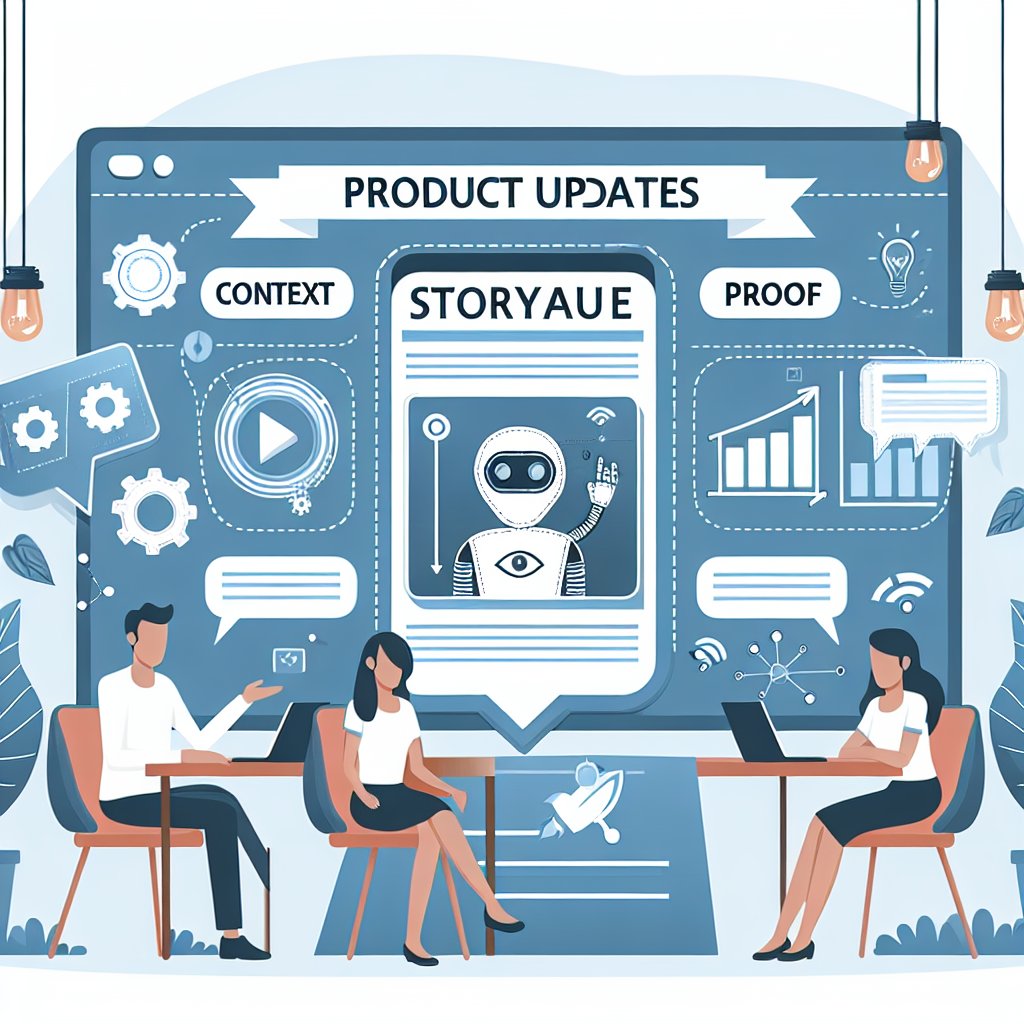
A strong product update is not just a list of changes. It is a small package of meaning that answers four user questions fast: What changed? Why did it change? What do I do differently? How do I know it worked? When you consistently answer those questions, updates stop feeling disruptive and start feeling like progress.
Below is an “operating system” you can reuse for announcements, improvements, and new features. It is designed for busy customers, multi-channel communication, and real-world constraints like support load, sales enablement, and the need to prove outcomes.
Most update posts fail for predictable reasons:
Fixing these issues does not require longer posts. It requires structure and repeatability.
PUOS is a repeatable template you can apply to every release, from a tiny UI tweak to a major new module. Think of it as a checklist for clarity.
Start by labeling the change internally, even if you do not show the label publicly. Each type has a different communication job:
Then write a one-sentence promise: “This update reduces time-to-complete X,” or “This update adds Y so you can achieve Z.” If you cannot write the promise, the message will drift.
The “why” is not your roadmap. It is the user’s reality. A useful framing is:
Example: “Teams told us assigning leads from WhatsApp to the right rep took too many clicks. We redesigned the routing step so you can auto-assign by region and deal type, and still override manually when needed.”
This kind of “why” works because it is anchored in a workflow, not a feature list.
Users do not think in components. They think in tasks. So describe changes in terms of actions and results.
Keep the list short and prioritize changes that alter behavior. If you have many minor items, bundle them under one line like “Stability and performance improvements across messaging channels.”
Impact creates belief. If you can include metrics, do it. If you cannot, include observable outcomes.
For business automation products, impact metrics often tie to revenue and operations: faster response, higher booking conversion, fewer missed leads, lower support volume.
This is where platforms like Staffono.ai can help you create real “before and after” evidence. Because Staffono’s AI employees handle customer communication and sales across WhatsApp, Instagram, Telegram, Facebook Messenger, and web chat, you can quantify improvements such as response time, lead qualification rates, booked appointments, and handoff efficiency when you ship changes to flows or routing rules.
Every update should include an action ladder. Not everyone needs the same next step.
Keep the first step extremely small. “Open settings and toggle X” beats “Read the documentation.”
Product updates should travel where users already work. For many businesses, that is messaging. A channel plan might look like:
If you run multi-channel communication, consistency is hard. This is another area where Staffono.ai fits naturally: you can deploy an AI employee that answers “What changed?” questions in real time inside the channels your customers use, and routes complex cases to a human. That reduces support spikes after releases and prevents confusion from spreading.
The fastest way to reduce friction is to predict it. Add a short FAQ section that includes:
Even if your answer is “No action required,” saying it explicitly is a service.
Scenario: You are expanding coverage to a new messaging channel.
What changed: “You can now connect Telegram conversations to your shared inbox.”
Why: “Many teams receive high-intent inquiries on Telegram and want them handled alongside WhatsApp and web chat.”
Impact: “Fewer missed messages, unified response metrics.”
Next step: “Connect Telegram in settings, then assign routing rules.”
If you use Staffono.ai, this type of update becomes immediately valuable because the same AI employee can handle Telegram alongside other channels, maintaining 24/7 responsiveness without adding headcount.
Scenario: Booking flows have drop-offs.
What changed: “We reduced the booking steps from five to three and added automatic time zone detection.”
Why: “Users were abandoning the flow on mobile when asked to pick time zones manually.”
Impact: “Higher completion rate, fewer rescheduling messages.”
Next step: “Test the new flow on mobile and update your booking link.”
Teams using Staffono.ai for bookings can pair the improvement with automated reminders and follow-ups in WhatsApp or Instagram, turning fewer drop-offs into more confirmed appointments.
Scenario: You launch AI-powered lead qualification.
What changed: “You can now define qualification questions and automatically score leads based on answers.”
Why: “Sales teams were spending too much time on low-intent inquiries.”
Impact: “Reps focus on ready-to-buy leads, faster pipeline movement.”
Next step: “Start with three questions, set a handoff threshold, monitor results for a week.”
In Staffono.ai, this is a common pattern: AI employees can qualify leads inside the conversation, capture details, and hand off to humans only when intent is high, which makes your feature announcement tie directly to measurable business outcomes.
Shipping is not the finish line. Track adoption and understanding:
If you are communicating via messaging, measure conversation outcomes. With Staffono.ai, you can monitor how customers respond across channels, which questions repeat, and where users get stuck, then use that insight to improve the next release announcement.
When you publish the post, keep it scannable:
Consistency is what builds trust. Users learn how to read your updates quickly, which increases adoption over time.
The best teams treat product updates as part of the product. Each announcement trains users, reduces uncertainty, and creates a feedback loop that improves the next release. Over months, that becomes a compounding advantage: faster adoption, fewer support spikes, and a clearer narrative of progress.
If your business communicates with customers across multiple messaging channels, consider using Staffono.ai to make update rollouts smoother: an AI employee can explain changes instantly in WhatsApp, Instagram, Telegram, Facebook Messenger, and web chat, guide users to the right next step, and collect feedback while your team focuses on shipping. When your product updates are supported by 24/7 conversational automation, “what changed and why” stops being a one-time post and becomes an always-on adoption engine.