

Product updates fail when they read like engineering diaries instead of customer decisions. This guide shows how to announce improvements and new features by explaining what changed, why it changed, and what users should do next, without overwhelming attention or increasing support volume.
Most product updates are technically correct and commercially ineffective. They list what shipped, link to documentation, and hope users connect the dots. The problem is not the pace of shipping, it is the clarity of the story. Customers do not adopt changes because you released them. They adopt changes because they understand the decision behind them and can predict how it improves their work.
A strong product update answers three questions in plain language: what changed, why it changed, and what you want the user to do next. That is it. Everything else is supporting detail. When teams get this right, announcements reduce confusion, shorten time to value, and create a measurable lift in activation and retention. When they get it wrong, release notes become noise, support tickets spike, and sales gets stuck explaining “what’s new” on every call.
Users interpret changes through risk and effort. Even a positive improvement can feel risky if it alters a familiar workflow. That is why “what changed” must be paired with “why it changed” and “how it affects me.” Consider these two announcements:
The second version gives a reason and an outcome. It also hints at what to expect. That reduces uncertainty, which is the hidden barrier to adoption.
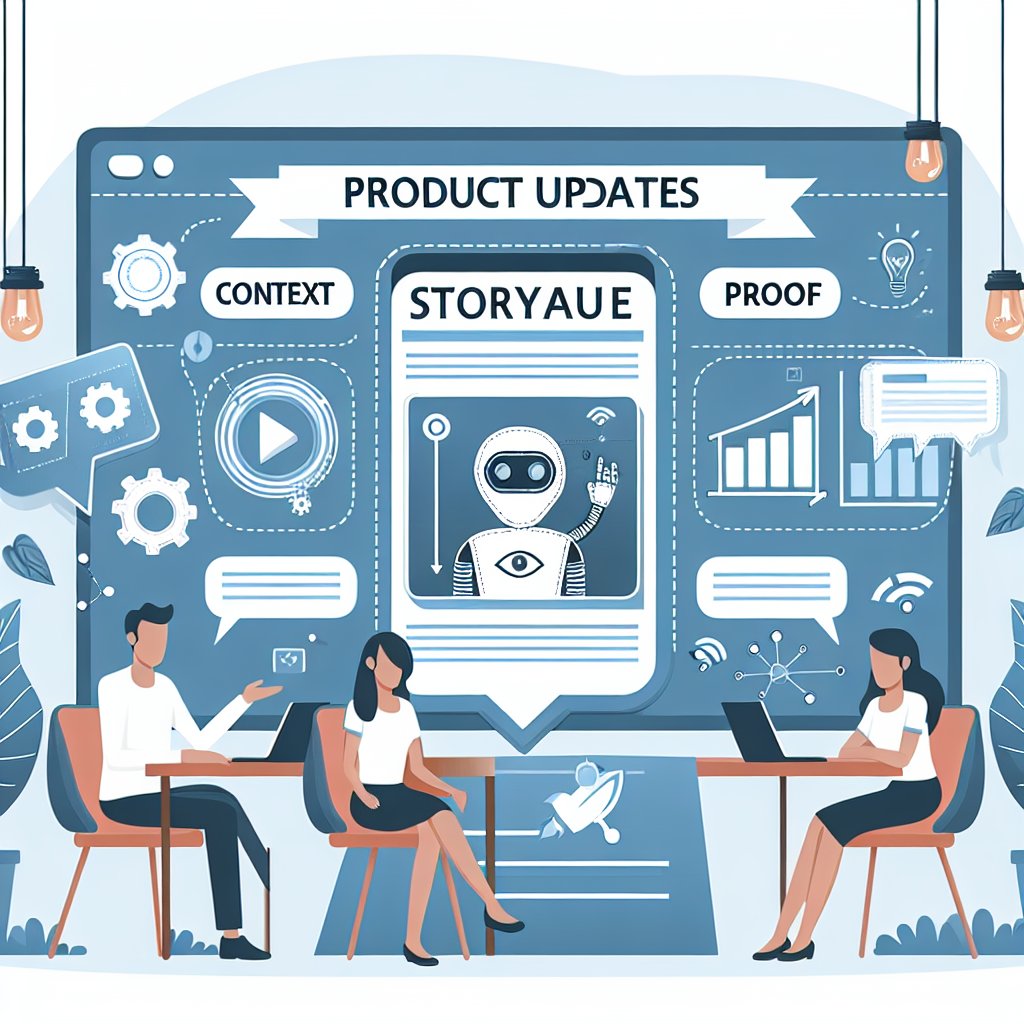
A useful model is to treat every update as a short decision memo. You are explaining a choice your product made on the user’s behalf. Decision memos work because they preserve context and make tradeoffs explicit. For product updates, you can keep it simple with five blocks:
This structure scales from small fixes to major releases. It also forces teams to avoid vague statements like “performance improvements” without saying what got faster and for whom.
The highest performing product announcements typically lead with an outcome. Users scan quickly. If the first sentence does not map to a goal they care about, they leave. Try this pattern:
This is also where AI products can shine, because the outcome can be expressed in business terms: faster responses, fewer handoffs, more qualified meetings, better conversion.
Abstract claims do not help users imagine the change. Concrete examples do. If you are building for messaging and lead capture, examples should look like actual chat snippets or scenarios. For instance:
What changed: Booking confirmations now include an automatic reschedule link and a calendar file.
Why: Users asked for fewer no-shows and less back-and-forth to adjust appointment times.
Impact: Customers can reschedule without calling. Your team spends less time on scheduling admin.
Action: If you use custom confirmation templates, review the new variables and update the message.
If you run customer communication across multiple channels, you can also show a cross-channel example. This is where Staffono.ai (https://staffono.ai) is a useful reference point: many businesses need one consistent experience across WhatsApp, Instagram, Telegram, Facebook Messenger, and web chat. A product update should tell those businesses whether the change is consistent across channels, and what edge cases to expect.
Categorization helps, but only if the categories do not become a dumping ground. Users care about outcomes, not taxonomy. A practical approach is:
Within each category, lead with the most important user outcome. If you shipped ten fixes, summarize the theme in one sentence, then list the key items. “Fixed a rare bug in webhook retries” is useful for some readers, but “More reliable delivery of messages to your CRM” is useful for almost everyone.
“Why” is not a status update about your sprint. It is the user problem and the design intent. Good “why” statements look like:
Notice that none of these explain the internal debate. They explain the customer value. If there were tradeoffs, mention them briefly and give users control where possible. “We tightened spam filtering, which may block some edge-case messages. You can whitelist trusted domains.” That builds trust.
Many update posts end after describing the change. That is where adoption dies. Every update should have a clear next step, even if the next step is “do nothing.” Good action guidance includes:
If the update affects customer messaging, include a checklist to avoid brand mistakes. For example, if you changed templates or routing, remind teams to verify tone, compliance language, and escalation paths. Platforms like Staffono.ai often sit at the center of customer communication, so a small misconfiguration can echo across multiple channels. A crisp action step prevents that.
Not every update deserves the same megaphone. Use different surfaces for different needs:
If you serve customers through messaging, consider also using a conversational channel for updates. For example, an AI assistant can answer “What changed?” and “How do I enable it?” in real time. This is a natural fit for Staffono.ai: because it operates 24/7 across popular messaging apps, it can help businesses communicate changes to their own customers, route questions to the right team, and reduce support load during rollouts.
Product updates are only successful if behavior changes. Pick one primary metric per update and one supporting metric:
Then connect the measurement back into the next update. “Last month we introduced auto-qualification. Teams using it saw 18 percent more booked meetings, so this month we added better fallback questions for ambiguous inquiries.” That creates continuity and credibility.
If you want a repeatable format that stays customer-focused, use this:
Teams that publish consistently with a template see compounding benefits: fewer internal questions, fewer support escalations, and a tighter loop between product, marketing, and sales.
As your product and customer base grow, the hard part is not writing one announcement. It is delivering the right version of the announcement to the right person at the right time, then handling the follow-up questions. Automation helps with:
Staffono.ai (https://staffono.ai) is built for exactly this kind of operational reliability. With AI employees that manage conversations across WhatsApp, Instagram, Telegram, Facebook Messenger, and web chat, businesses can keep customers informed during changes, protect conversion during high volume periods, and ensure nobody gets stuck waiting for answers after hours.
The best product update strategy is not louder announcements. It is a series of small promises that users can verify in their daily work. Lead with outcomes, explain the decision, give a clear next step, and measure behavior. Do that repeatedly and your changelog stops being a list of features and becomes a trust-building asset.
If you want your updates to translate into faster responses, cleaner lead capture, and more bookings across every messaging channel, Staffono.ai can help you operationalize the communication side of change. Explore Staffono at https://staffono.ai to see how AI employees can announce updates, answer questions 24/7, and route conversations so your team stays focused on high-value work.