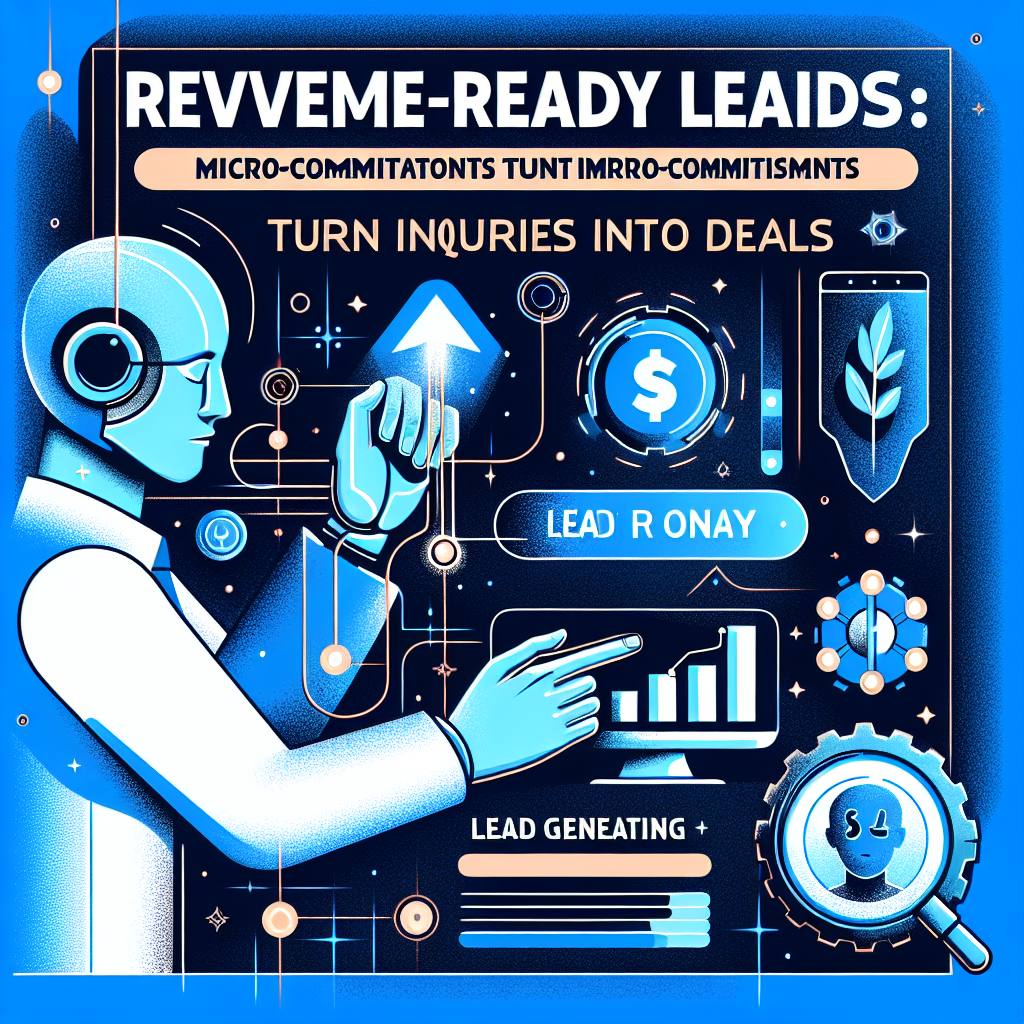

Lead generation is easier than revenue when every inquiry gets treated the same. This guide shows how to capture better signals, qualify faster, and convert consistently using messaging-first tactics, practical scripts, and automation that never sleeps.
Most teams do not have a “lead generation” problem. They have a “signal management” problem. Leads arrive from ads, referrals, social DMs, web chat, and WhatsApp, but the business treats them like identical tickets. The result is predictable: slow replies, vague qualification, and follow-ups that depend on someone remembering to do them.
To turn leads into revenue, you need an engineered journey, a system that captures intent signals, qualifies with purpose, and moves the right prospects forward with clear next steps. Messaging channels are the perfect place to do this because they compress the distance between interest and action. When done well, your first conversation becomes your best sales asset.
Below is a practical playbook to capture, qualify, and convert leads into revenue, with examples you can use immediately and ways to automate the process with Staffono.ai (https://staffono.ai) so it runs 24/7 across WhatsApp, Instagram, Telegram, Facebook Messenger, and web chat.
Capturing leads is not just about forms and landing pages. It is about making the first micro-decision easy: “Yes, I will start this conversation.” In messaging, the capture mechanism is the prompt you place in front of the prospect and the speed at which you respond.
Prospects behave differently depending on where they meet you. Optimize each channel for its native behavior.
Long forms often reduce conversion at the exact moment intent is highest. In messaging, the goal is to capture just enough to continue the conversation intelligently.
Example opener that captures intent without friction:
“Hi! What are you looking to achieve: (1) pricing, (2) availability, (3) recommendation, or (4) something else?”
If your first reply arrives 30 minutes later, you are competing with the next tab, the next ad, and the next distraction. Fast response is not only a service metric, it is a conversion lever. This is where an always-on responder pays for itself. Staffono.ai can act as a 24/7 AI employee that greets, answers common questions, and routes conversations instantly, so you do not lose high-intent leads overnight or during peak times.
Qualification fails when it feels like an interrogation. The best qualifying flows feel like help. They narrow choices, confirm fit, and earn the right to ask for details.
Instead of generic BANT checklists, use three categories that work across most industries:
Practical qualification questions that do not feel heavy:
Branching means you do not ask everyone the same questions. You ask the next best question based on what they said. In a salon, “availability” should lead to date and service type. In B2B software, it should lead to team size and use case.
Example branching flow for a service business (fitness coaching):
Staffono.ai can automate these branching paths across messaging channels, ensuring the same qualification logic runs consistently whether the lead comes from Instagram DMs at 11 pm or web chat at noon. The key is consistency: every conversation collects the signals your sales team needs.
A lead score is useful, but an outcome is actionable. End each qualification with one of these states:
This reduces the “maybe” pile that clogs pipelines.
Conversion is rarely about more persuasion. It is about removing uncertainty. Prospects hesitate when they cannot picture the next step, fear hidden costs, or do not trust that you understand their situation.
Choice overload slows decisions. Present two relevant options anchored to their signals.
Example for a B2B agency lead:
Generic testimonials are less persuasive than contextual proof. Keep a small library of proof snippets categorized by industry, channel, and goal.
If you do not have formal case studies yet, use “process proof” such as screenshots of your booking flow, response time metrics, or a short walkthrough video.
Most objections repeat. Write them once, then reuse consistently.
Every conversation should end with one clear action. Avoid ending with “Let me know.” Use:
Example close in messaging:
“If you want, I can reserve a slot for Wednesday at 3:00 or Thursday at 11:00. Which works?”
Many leads do not convert on the first touch. They convert when you follow up with relevance. The mistake is sending generic “checking in” messages that add no value.
Follow-up fails because it is manual. With Staffono.ai, you can set rules like: if a lead asked for pricing but did not book, send a helpful message in 2 hours, then a proof snippet the next day, then offer a booking link. Since Staffono.ai operates across WhatsApp, Instagram, Telegram, Facebook Messenger, and web chat, you can keep the conversation in the channel the prospect already chose.
Do not measure only lead volume. Measure quality and movement. A simple dashboard can change behavior.
When you see where drop-offs happen, you can fix the specific step rather than “work harder” across the whole funnel.
If you want a straightforward structure, implement this:
This is exactly where AI-driven automation can compound results. Staffono.ai can handle the repetitive parts of capture, qualification, booking, and follow-ups as an always-on AI employee, while your team focuses on high-value conversations and closing.
If you are ready to turn messaging into a predictable revenue channel, explore how Staffono.ai (https://staffono.ai) can help you respond instantly, qualify with consistent logic, and convert more leads across every major chat platform, without adding headcount.