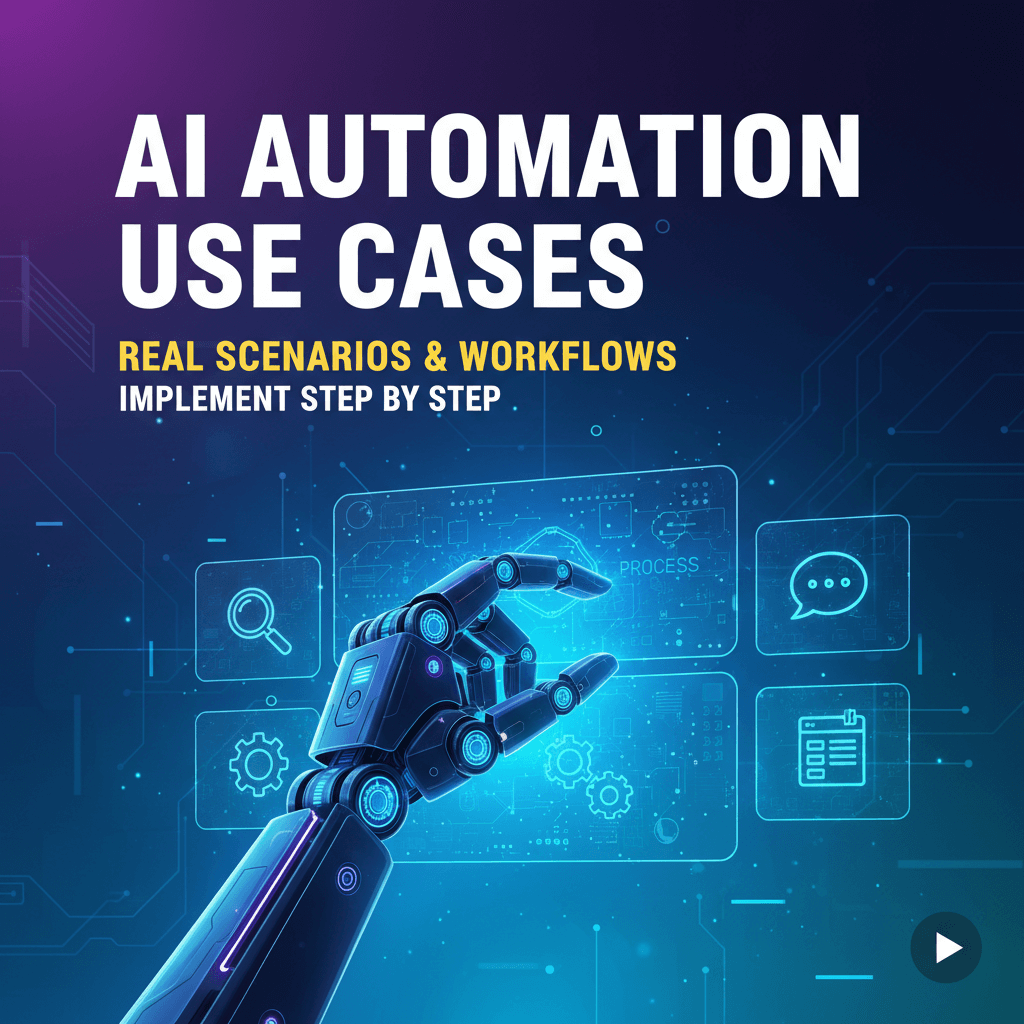
AI automation is no longer an experiment, it is a practical way to capture leads, respond faster, and scale customer communication without growing headcount. Below are real-world use cases with step-by-step workflows you can implement across WhatsApp, Instagram, Telegram, Messenger, and web chat.
Most businesses do not struggle because they lack demand. They struggle because demand arrives in bursts, across too many channels, and outside working hours. Messages pile up, follow-ups slip, and leads go cold. AI automation solves this by turning your customer communication into consistent, trackable workflows that run 24/7.
This article focuses on practical use cases you can implement step by step. Each scenario is designed for messaging-first businesses where conversations happen on WhatsApp, Instagram, Telegram, Facebook Messenger, and web chat. Platforms like Staffono.ai are built for exactly this environment, providing AI employees that can handle inquiries, qualification, bookings, and sales conversations around the clock while keeping your team in control.
Use case 1: Instant lead capture and qualification from ads and social DMs
Scenario: You run ads or post content that drives people to DM you. The biggest leak is time: if you reply in 2 hours instead of 2 minutes, the lead often moves on.
Step-by-step workflow
- Define your lead sources and entry points. Decide which channels you will treat as primary, for example Instagram DMs and WhatsApp clicks from ads, plus web chat on your landing pages.
- Create a short qualification path. Keep it to 3 to 5 questions: need, timeline, budget range, location, and preferred contact method. The goal is not to interrogate, it is to route.
- Set intent detection and routing rules. Identify keywords like “price,” “book,” “available,” “delivery,” “consultation,” then route to the right flow.
- Collect structured data. Capture name, phone, email (if relevant), and key qualifiers in a consistent format so your CRM and sales team can act.
- Offer a next action. Provide a booking link, a catalog, or a quick quote. If the lead is qualified, offer handoff to a human.
- Trigger follow-ups automatically. If a lead stops responding, send a helpful follow-up after 30 minutes, then 24 hours, then 3 days, with value like FAQs or case examples.
How Staffono.ai helps: Staffono.ai can run this qualification flow across multiple messaging channels and keep conversations consistent. Your AI employee can capture structured lead details, tag intent, and push qualified leads to your team or systems, reducing response time and improving conversion rates.
Use case 2: Appointment booking that actually reduces no-shows
Scenario: You offer services that require scheduling: clinics, salons, consultants, real estate showings, demos, and more. Manual booking creates back-and-forth and missed messages, and no-shows waste capacity.
Step-by-step workflow
- Define booking rules. Business hours, service durations, buffer times, and required details (name, phone, service type, location).
- Implement availability presentation. Offer 3 to 5 available slots instead of asking “When are you free?” This reduces friction.
- Confirm and summarize. Send a clear confirmation message with date, time, address, and rescheduling link.
- Automate reminders. Send reminders at sensible intervals, for example 24 hours and 2 hours before the appointment.
- Enable rescheduling and cancellation. Make it easy. Customers who can reschedule are less likely to disappear.
- Track outcomes. Mark appointments as attended, canceled, rescheduled, or no-show. Use this data to improve your reminder timing and messaging.
How Staffono.ai helps: With Staffono.ai, an AI employee can manage booking conversations 24/7 on WhatsApp, Instagram, and web chat, confirm details, and handle rescheduling. This is especially valuable when customers message late at night or between meetings, when speed determines whether the booking happens.
Use case 3: E-commerce product discovery and sales assistance in chat
Scenario: Customers ask questions like “Which model is best for me?” or “Do you have this in size M?” If your team replies slowly or inconsistently, carts get abandoned.
Step-by-step workflow
- Map common intents. Product availability, sizing, shipping, returns, warranty, payment, and comparisons.
- Build a guided product finder. Ask 2 to 4 preference questions: use case, budget, size, color, features.
- Recommend products with clear reasoning. Provide 2 to 3 options and explain why each fits. Keep it concise.
- Handle objections. If they ask about price, offer bundles, financing options, or highlight value points like warranty and free returns.
- Recover carts. If a customer stops after receiving a link, follow up with a reminder and a quick help prompt.
- Escalate when needed. For complex questions, transfer to a human with context: customer preferences and products already discussed.
How Staffono.ai helps: Staffono.ai can act as a sales assistant that answers product questions and guides customers to the right choice across messaging channels. It keeps your tone consistent, supports your team during peak times, and can drive more checkouts by reducing friction in the decision-making moment.
Use case 4: Customer support triage and self-service that feels human
Scenario: Support teams are overwhelmed with repetitive questions: order status, delivery windows, return policies, account access, and basic troubleshooting. Customers want immediate answers, not a ticket number.
Step-by-step workflow
- Create a tiered support menu. Start with the most common categories and allow free-text questions.
- Answer from a controlled knowledge base. Use approved policies, FAQs, and product documentation to avoid inconsistent answers.
- Collect identifiers early. Order number, email, phone, or booking reference, so you can locate the case quickly.
- Triage by urgency. Route “payment failed” or “delivery issue today” to priority handling.
- Offer resolution and next steps. Provide the exact action: return link, troubleshooting steps, or escalation to a human agent.
- Close the loop. Ask if the issue is resolved and collect a quick satisfaction response.
How Staffono.ai helps: Many businesses use Staffono.ai to reduce first-response time and handle repetitive support requests without sacrificing quality. Your AI employee can resolve common issues instantly, and hand off complex cases with a clean summary so your human team spends time where it matters.
Use case 5: Lead reactivation and pipeline follow-up without being spammy
Scenario: You have old leads sitting in a spreadsheet or CRM. They were interested once, but you never followed up consistently. Reactivation can be one of the highest ROI activities if done politely and with value.
Step-by-step workflow
- Segment your old leads. By service interest, last contact date, and stage (inquiry, quote sent, demo requested).
- Write two value-first messages. Examples: a new offer, a new case study, a helpful checklist, or a seasonal reminder.
- Use a conversational question. “Are you still looking to solve X?” or “Would you like options for Y?”
- Branch based on replies. Interested leads go to qualification and booking. Not interested leads get tagged and excluded from future outreach.
- Schedule follow-ups. One gentle follow-up if no response, then stop. Respect matters for deliverability and brand trust.
- Measure outcomes. Track reply rate, qualified rate, and booked meetings per segment to refine your targeting.
How Staffono.ai helps: Staffono.ai can run structured reactivation conversations over messaging, keeping the tone helpful and consistent. It can also qualify responses automatically and route warm leads back to your sales pipeline with full context.
Implementation checklist: how to launch your first workflow in a week
If you want results quickly, avoid trying to automate everything at once. Choose one high-volume conversation type and make it excellent.
What to do first
- Pick one use case with clear ROI. Lead qualification or booking is often the fastest win.
- List the top 20 customer questions. Use real chat logs, not assumptions.
- Define your handoff points. Decide when the AI employee should escalate to a human and what information must be included.
- Set success metrics. Examples: response time, lead-to-meeting rate, booking completion rate, support resolution rate, and no-show rate.
- Launch, then iterate weekly. Review transcripts, identify drop-offs, and refine prompts, flows, and knowledge base entries.
When you implement these workflows, the goal is not to replace your team. It is to remove bottlenecks so your people can focus on high-value conversations. With an AI employee handling repetitive questions, qualification, and scheduling, your business becomes faster, more consistent, and easier to scale.
If you want to deploy these use cases across WhatsApp, Instagram, Telegram, Facebook Messenger, and web chat without building everything from scratch, Staffono.ai is designed to help. You can start with one workflow, prove ROI, and expand to more customer journeys as you grow, all while keeping a clear view of conversations, handoffs, and outcomes.