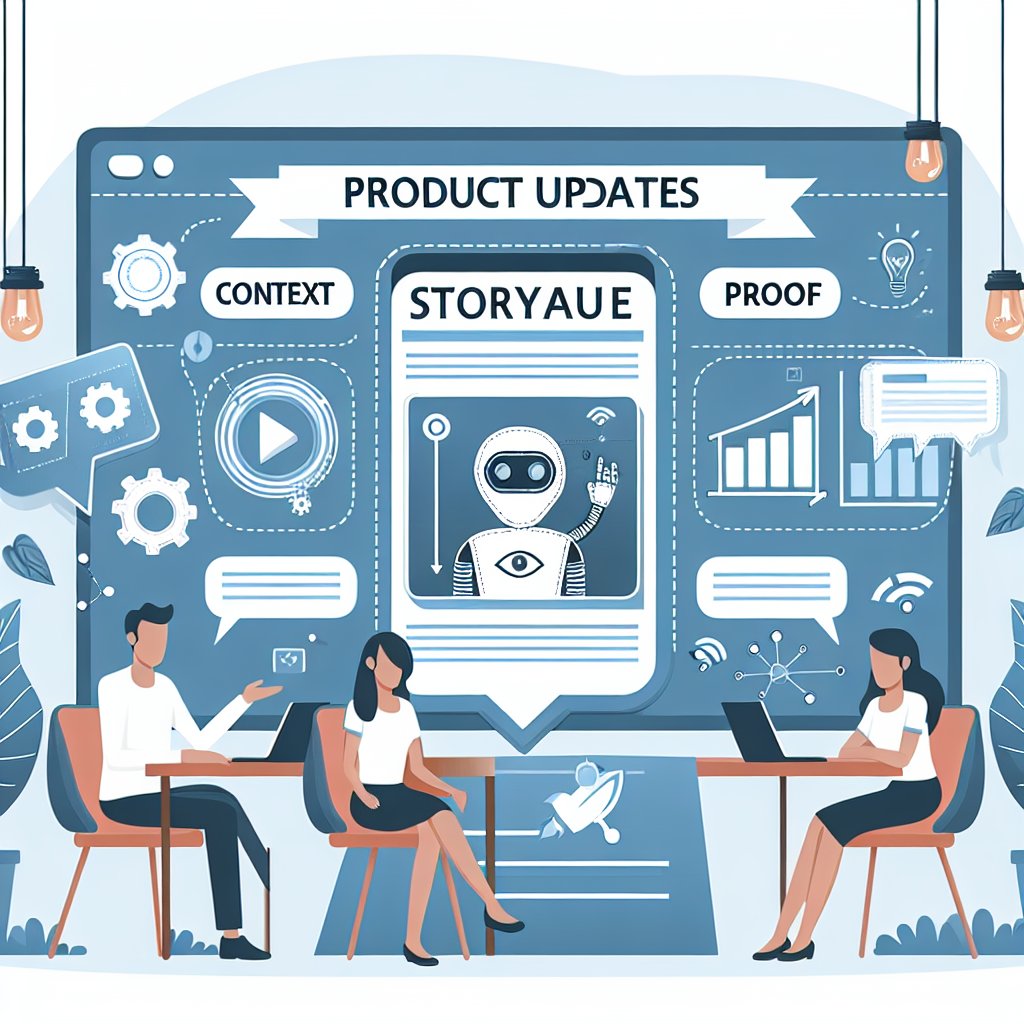


Most product updates fail not because the work is bad, but because the explanation is incomplete. This guide shows how to announce improvements and new features with enough “why” to reduce confusion, protect trust, and drive adoption across every channel.
Product updates are rarely just “new features.” They are changes to habits, expectations, workflows, and sometimes pricing or permissions. Customers do not evaluate an update only by what shipped, they evaluate it by how it affects their day. That is why the most effective product update communication has a clear “why layer” that explains what changed, why it changed, and what the customer should do next.
When the why layer is missing, teams pay the price in support tickets, churn risk, and silent non-adoption. When the why layer is strong, announcements become a growth lever: customers understand the benefit, trust the intent, and take action quickly.
Release notes often list changes accurately but still leave users confused. The gap is meaning. Customers want to know:
Think of every update as a small migration. Even if nothing “breaks,” users are mentally migrating from the old behavior to the new behavior. Your job is to make that migration feel intentional and safe.
Before you publish any announcement, draft answers to these six questions. If you cannot answer one in plain language, that is a signal the update is not yet explainable.
Describe the change at the level of the user interface or workflow, not the internal system. Replace “refactored settings architecture” with “settings are now grouped by team, notifications, and integrations.”
Give the motivation in one sentence. Examples: “to reduce duplicate work,” “to improve accuracy,” “to make approvals easier on mobile,” or “to comply with new regulations.” Avoid generic lines like “to improve your experience” unless you follow with specifics.
Not every customer needs every detail. Call out the main audience: “For sales teams,” “for admins,” “for busy operators handling messages,” or “for anyone managing multiple locations.” This prevents customers from assuming the change will disrupt them when it may not.
Even if the answer is “nothing,” say so explicitly. If action is required, give the shortest path: one link, one button name, one estimated time.
This is where you prevent support tickets. Use a short comparison: “Previously X, now Y.” If something moved, say where it moved. If something was renamed, list the old and new labels.
Customers relax when they know there is a safety net. If there is a way to revert settings, mention it. If not, say how to get help quickly.
Most updates contain a mix: bug fixes, small improvements, and one or two meaningful features. Customers do not read like product managers. Package your updates in a scan-friendly way:
This structure also helps your internal teams. Sales can spot what to mention. Support can spot what to prepare for. Customer success can spot which accounts need proactive outreach.
Here are three example announcement patterns you can copy and adapt.
What changed: “The ‘Leads’ tab is now called ‘Inbox’ and includes both new inquiries and ongoing conversations.”
Why: “Teams told us lead follow-up and active chats were split across two screens, which caused missed responses.”
What to do: “No setup required. If you used bookmarks, update them to /inbox.”
What’s different: “Previously, only new leads appeared in Leads. Now Inbox shows the full conversation history.”
What changed: “Unanswered messages now trigger an escalation notification after 10 minutes.”
Why: “We saw delayed first replies strongly correlate with lost bookings.”
What to do: “Admins can set the threshold to 5, 10, or 20 minutes in Settings.”
Safety: “Escalations are notifications only, they do not send messages to customers.”
What changed: “You can now add required fields to your booking form.”
Why: “Incomplete booking details create back-and-forth messaging and no-shows.”
What to do: “Start with one required field like phone number. Too many required fields can reduce conversion.”
Support plan: “If conversion drops after enabling required fields, contact us to review your setup.”
“We launched X” is not enough. Customers need “so you can do Y.” Put the benefit in the first paragraph, not the last.
If your customers discover changes in the UI before they see the announcement, they feel surprised, not helped. Use at least two surfaces: in-app plus email, or in-app plus a help article.
Too much detail creates the same confusion as too little. Provide a quick summary plus a clear “learn more” path.
Support and sales need a pre-brief. If customers ask questions and your team is learning in real time, trust drops.
As your product and customer base grow, manual announcements become inconsistent. This is where automation helps: you want the right message delivered to the right customer segment at the right time, with a clear next step.
Staffono.ai (https://staffono.ai) is designed for exactly this kind of operational communication across messaging channels. If your customers live in WhatsApp, Instagram, Telegram, Facebook Messenger, or web chat, Staffono can act like a 24/7 AI employee that:
This reduces support load while keeping customers confident during change.
Use this checklist each time you ship improvements or new features.
Staffono.ai can support this loop by handling repetitive “how do I” questions automatically, collecting structured feedback from customers in chat, and surfacing patterns to your team so your next update is easier to adopt.
Shipping is only half the job. Communication quality is measurable. Use a few simple indicators:
If you have high confusion, it usually means one of the six questions was not answered clearly, or the announcement did not reach customers where they pay attention.
Not every update needs a long story. Bug fixes, performance improvements, and security patches can be summarized, but still benefit from a why line: “We fixed duplicate notifications to reduce noise.” The goal is not length, it is clarity. Customers should finish reading and know what changed, why it matters, and what to do next, if anything.
If you want to make product updates feel calm and actionable across WhatsApp, Instagram, Telegram, Facebook Messenger, and web chat, Staffono.ai (https://staffono.ai) can help you deliver consistent explanations, guide users through new flows, and keep responses fast even outside business hours. When the why layer is delivered where customers already talk to you, updates stop feeling like disruptions and start feeling like progress.