

Product updates fail when teams treat announcements like a single post instead of a coordinated communication system. This guide shows how to package improvements and new features into clear, low-friction messages that customers actually understand, adopt, and trust.
Most product updates do not fail because the change was bad. They fail because the communication was incomplete. Customers read an announcement, misunderstand what it means for their workflow, and then either ignore it or open a support ticket. Internally, teams feel like they shipped something valuable but adoption stays flat. The gap is rarely the feature itself. It is the way the change was explained, delivered, repeated, and reinforced across the channels where customers actually pay attention.
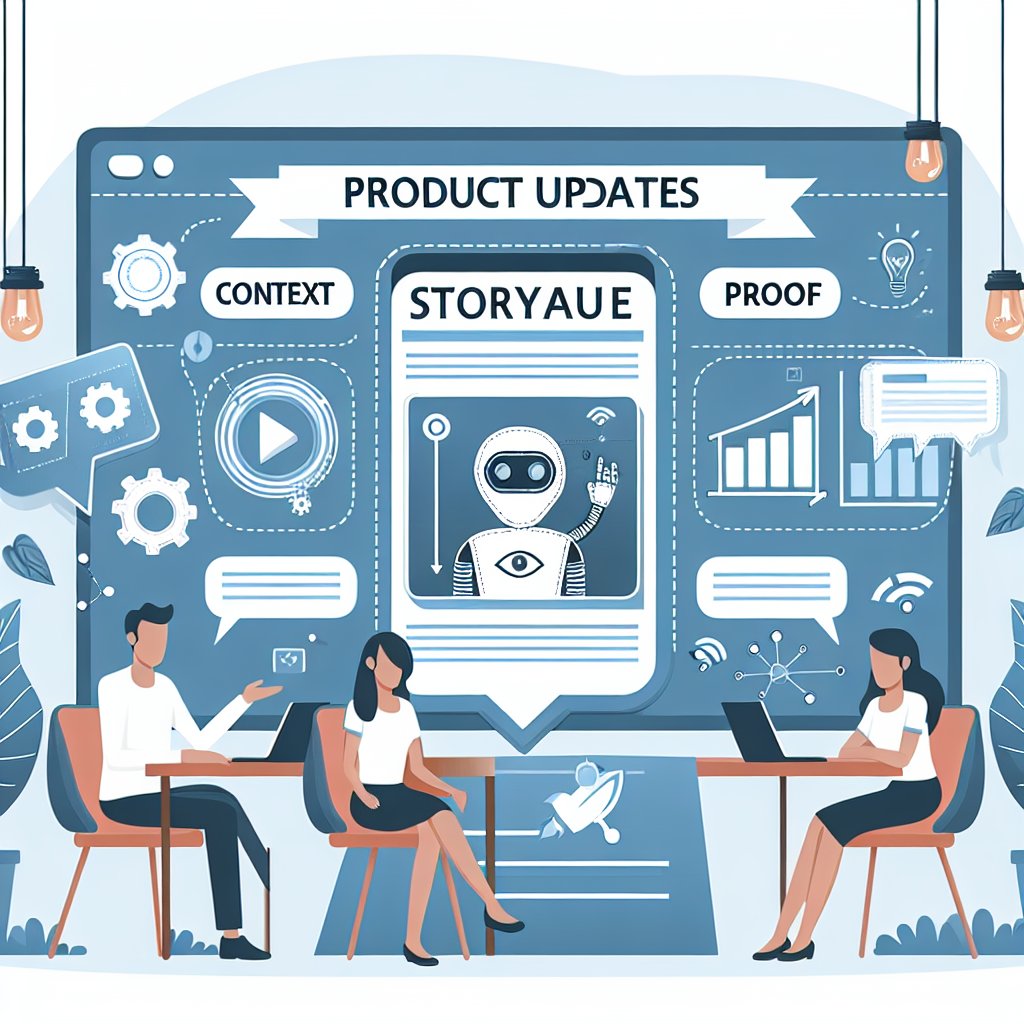
Thinking in terms of a product update communication stack helps. A stack is not one announcement. It is a set of coordinated layers that answer different customer questions at different moments: What changed, why it changed, who it affects, what to do next, and where to get help. When your stack is consistent, updates turn into momentum instead of noise.
Even well-written release notes can miss the real job customers hire them for: reducing uncertainty. Customers do not wake up wanting “new features.” They want predictable outcomes: fewer errors, faster work, fewer manual steps, and less risk. If your announcement does not connect the change to those outcomes, it is just information.
Common causes of confusion include:
A reliable stack contains five layers. Not every update needs every layer, but every update benefits from the same structure.
This is the simplest description of the change in plain language. It should answer: “What is different now?” Keep it concrete and specific.
Example: “You can now confirm bookings directly in WhatsApp with one tap.”
A repeatable headline matters because customers will paraphrase it to colleagues. If it is vague, the message degrades as it spreads.
Customers want to know why you touched something that already worked. The why should point to a user problem, not an internal goal.
Example: “We saw missed appointments due to slow confirmation loops, so we shortened the process to a single tap.”
When you explain the why, you prevent the silent fear that the change is just change for its own sake.
Impact mapping turns a general announcement into a decision guide. Segment by role, plan, or workflow. Use short bullets so a reader can immediately self-identify.
Impact mapping is where you prevent support tickets. It is also where you show respect for the customer’s time.
Proof can be qualitative or quantitative. It can be a short metric, a before/after, or a customer quote. The goal is not bragging. The goal is credibility.
Example: “In beta, confirmation time dropped from 2 minutes to 15 seconds, and no-show rates decreased in three test locations.”
Even if you do not have big numbers, you can provide proof through clarity: what exactly you changed, what you tested, and what guardrails exist.
Announcements are remembered where work happens. For many businesses, that is messaging. If customers book, ask questions, and negotiate in WhatsApp or Instagram, your update must appear there too.
This is where platforms like Staffono.ai fit naturally. Staffono provides 24/7 AI employees that communicate across WhatsApp, Instagram, Telegram, Facebook Messenger, and web chat. When you ship an update, Staffono can reinforce it in the same channels customers already use, answer questions instantly, and guide users through the new behavior step-by-step.
Customers do not think in terms of “backend refactors” or “UI updates.” They think in terms of intent. When you package changes around intent, your update becomes easier to understand and easier to act on.
Three practical packaging types:
Within each type, keep the message outcome-based: “what you can do now” and “what you no longer need to do.”
Scenario: You changed how leads are routed to sales reps.
What changed: “New inquiries are now assigned based on region and response time.”
Why: “Prospects were waiting too long when one rep was overloaded.”
Impact: Sales managers see fewer unassigned leads. Reps get notifications faster. Admins can override routing rules.
Reinforcement: A short in-chat message to sales reps the first time a routed lead arrives, explaining what to do next.
With Staffono.ai, this reinforcement can happen automatically. If a rep asks, “Why did I get this lead?” Staffono can explain the rule and link to the settings, reducing internal back-and-forth.
Scenario: You improved response accuracy for automated replies.
What changed: “Smarter answers for pricing and availability questions.”
Why: “Customers were asking the same questions in different ways, and we want consistent answers.”
Proof: “Fewer handoffs to human agents in the last two weeks of testing.”
Next step: “Review your FAQ and add two examples of how customers ask about pricing.”
This is also where an AI automation platform can be part of the story. Staffono.ai can help businesses keep answers consistent across channels, and because it runs 24/7, the improvement shows up when customers actually message, not only during office hours.
Scenario: You introduced automated booking reminders.
What changed: “Automatic reminders now go out 24 hours and 2 hours before an appointment.”
Why: “To reduce no-shows and last-minute rescheduling.”
Impact: “Admins can set reminder windows. Customers can confirm or reschedule directly in chat.”
Reinforcement: “The first reminder includes a short explanation and a one-tap action.”
Notice the difference between shipping the feature and shipping the understanding. The latter is what drives adoption.
Instead of posting everything in one place, plan a simple cadence. You do not need a big campaign, but you do need repetition across touchpoints.
For messaging-first businesses, the “primary channel” is often chat. Staffono.ai can deliver these reminders via WhatsApp, Instagram, Messenger, Telegram, and web chat, and it can respond in real time when a customer replies with confusion or objections.
Do not only measure opens and clicks. Measure behavior. A practical measurement set includes:
If you automate customer communication, you can also measure conversation outcomes: fewer “how do I” questions, faster booking confirmations, and more qualified leads. Staffono.ai is designed around these real business outcomes, helping teams connect product changes to measurable improvements in messaging, booking, and sales operations.
Use this template to keep every update clear:
The best product updates feel like the product got easier overnight. That only happens when communication meets customers where they work and removes extra steps. If your customers live in messaging channels, your update strategy should live there too, with quick answers, guided setup, and friendly reminders that do not require a support ticket.
If you want a practical way to deliver that experience, consider using Staffono.ai to operationalize your update communication stack. With AI employees available 24/7 across WhatsApp, Instagram, Telegram, Facebook Messenger, and web chat, Staffono can announce what changed, explain why in plain language, and help customers take the next step right inside the conversation. That is how updates stop being a broadcast and start becoming adoption.