
Most product announcements fail for one simple reason: they describe what shipped, but not what actually changed for the user. In this post, you will learn how to write product updates like a diff review, clearly mapping old behavior to new behavior and explaining why the change matters.
Product updates are not just announcements. They are a translation job between what your team built and what your customers must do differently tomorrow. When updates are vague, users feel friction: something moved, something behaves differently, something “seems slower,” and suddenly support volume rises, adoption drops, and trust erodes.
A useful way to fix this is to treat every update like a diff review. In engineering, a diff shows exactly what changed: what was added, removed, or modified. Users need the same clarity, just expressed in product language. Instead of “New dashboard improvements,” they need “The filter now defaults to last 30 days instead of last 7 days, so reports match your billing cycle.” That is the difference between information and understanding.
Many release notes list features, but customers evaluate change through outcomes and habits. They ask: Will my workflow break? Will my metrics change? Do I need to retrain my team? If you do not answer those questions, your update becomes background noise, or worse, a surprise.
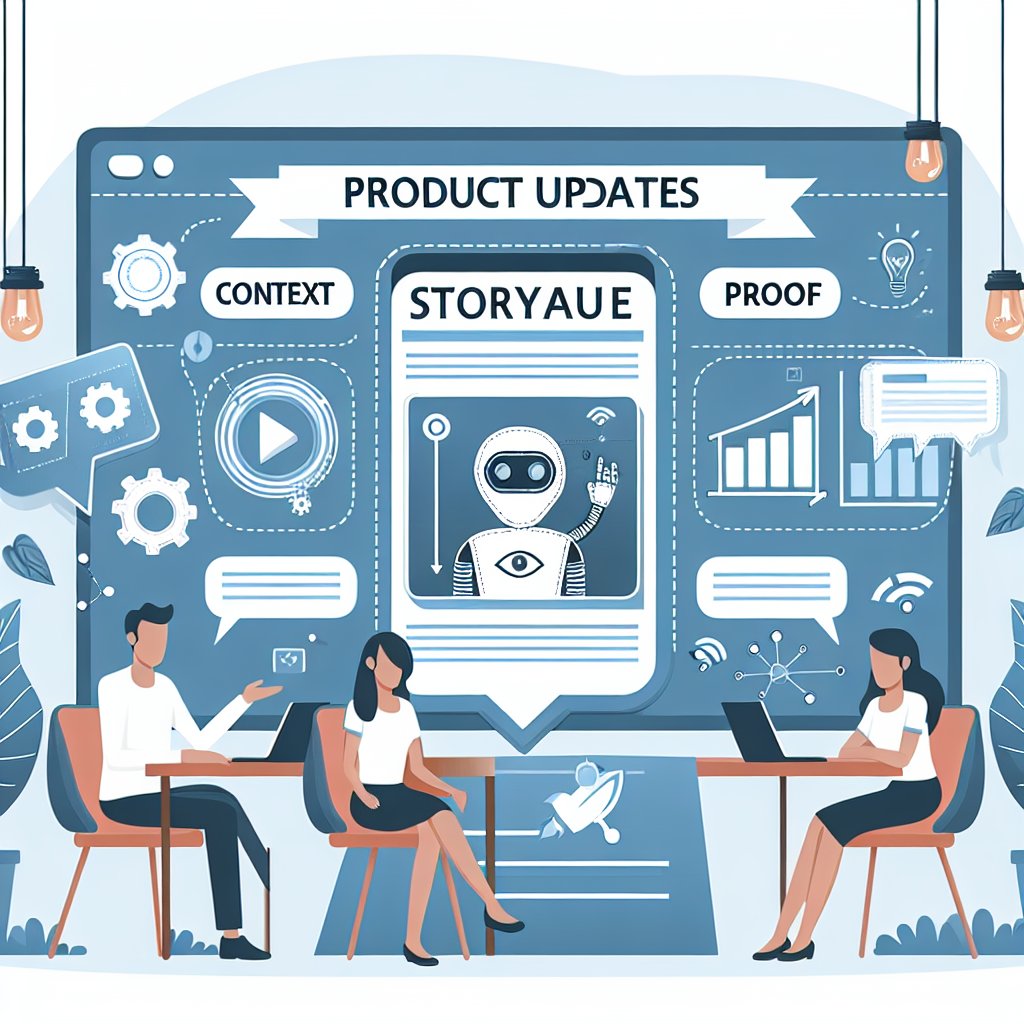
High-quality product updates connect four layers:
If any layer is missing, customers have to infer it. Inference is expensive and creates uncertainty.
You can make your announcements dramatically clearer by structuring each meaningful change as a mini diff. Use this pattern consistently:
Describe the previous behavior in plain language. Avoid blaming the past. Just state how it worked.
Describe the new behavior, including what is different in the UI and in the rules behind it (defaults, limits, edge cases).
Explain the reason, preferably tied to a user goal or a measurable problem (speed, fewer errors, better conversion, reduced risk).
Give a single recommended action. If no action is needed, say that explicitly.
This approach prevents “announcement fog.” It also makes it easier for customer success and sales to repeat the message accurately.
Below are examples that show how the same update can either confuse or clarify.
Vague: “We improved your notification settings for a better experience.”
Diff-style:
Notice how the user can immediately predict the impact and decide what to do.
Vague: “We reorganized the navigation.”
Diff-style:
This is a small change, but small changes break muscle memory. Diff-style notes respect that.
Vague: “We made the app faster.”
Diff-style:
When you claim improvement, quantify it. It turns skepticism into confidence.
Not every commit deserves a broadcast. The goal is not to publish more, it is to publish what changes decisions. Use these filters:
Minor bug fixes can stay in a rolling changelog. Workflow and outcome changes need narrative and guidance.
Users do not need internal debates or multi-page PRDs. They need a short, believable reason. Good “why” statements usually fit into one of these buckets:
If you can not explain why simply, it is often a sign the change is not clearly user-driven, or you have not found the right framing yet.
Even a perfect announcement fails if it is delivered in the wrong channel. Most teams rely on one place (a blog or a changelog), but users work in many places. A practical distribution mix includes:
This is where automation can make the difference between “we published it” and “customers absorbed it.” Staffono.ai (https://staffono.ai) can act as a 24/7 AI employee across WhatsApp, Instagram, Telegram, Facebook Messenger, and web chat, answering “what changed?” questions with the same diff-style clarity. Instead of customers waiting for support, they can ask in their preferred channel and get an immediate, consistent explanation.
When an update ships, the real work begins: questions, edge cases, confusion, and internal training. The best teams anticipate this by pairing the announcement with a support-ready FAQ and examples.
Create a small “impact kit” for each major update:
If you use Staffono.ai, you can load these FAQs into your automated messaging workflows so your AI employee can resolve common questions instantly, route complex cases to a human, and even collect feedback about what remains unclear. Over time, your update communication becomes measurable: you see what people ask, what they struggle with, and what documentation needs improvement.
Publishing is not the finish line. You need signals that users understood and adopted the change. Choose a small set of metrics based on the change type:
Because Staffono.ai supports messaging-first interactions, it can also help you capture post-update sentiment at scale. For example, after a user completes the new flow, your AI employee can ask one short question like “Did this new step save time, yes or no?” and tag responses for your product team.
For your next announcement, copy this structure and fill it in for each meaningful change:
Done well, product updates become a compounding asset. They reduce support, improve adoption, and teach customers how you think.
If you want your product updates to land in the same places your customers already communicate, and you want those announcements to turn into instant, helpful answers at any hour, Staffono.ai (https://staffono.ai) can help. With AI employees handling customer conversations across popular messaging channels and web chat, you can ship changes confidently, keep users informed in real time, and protect your team’s focus for the next release.