
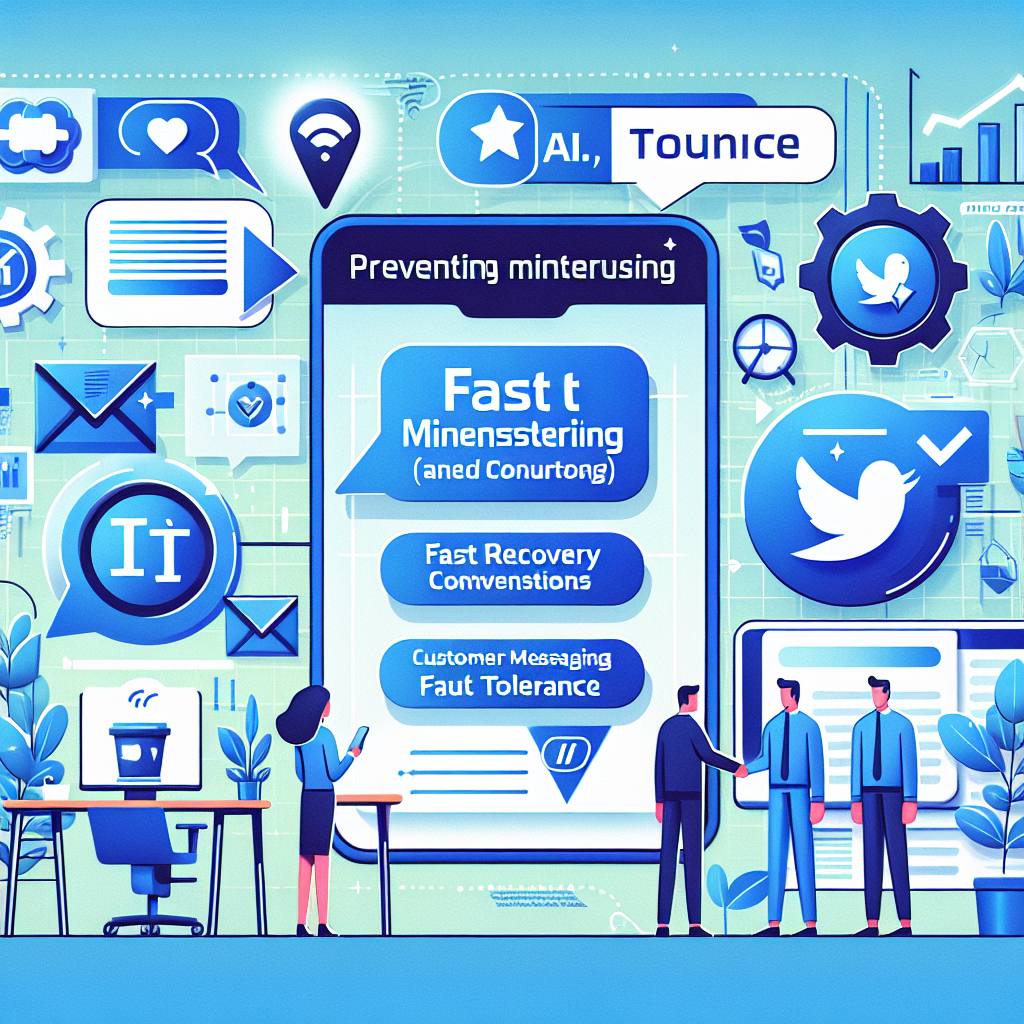
Most customer conversations do not fail because your team is slow, they fail because messages break under real-world conditions: missing context, mixed channels, unclear asks, and emotional moments. This guide shows how to design fault-tolerant messaging with practical strategies, reusable templates, and best practices that keep customers moving forward.
Customer messaging is not a copywriting problem, it is a reliability problem. In the real world, customers reply out of order, switch channels mid-thread, ask three questions at once, and message you at 2:00 a.m. Meanwhile your team is juggling tools, handoffs, and partial context. When messaging breaks, the symptoms look familiar: confusion, long back-and-forth, missed bookings, abandoned carts, and avoidable refunds.
Fault-tolerant messaging means your conversations keep working even when conditions are messy. You design messages that survive missing details, handle ambiguity, and recover gracefully when something goes wrong. The payoff is simple: fewer misunderstandings, faster decisions, and a customer experience that feels calm and competent.
Below are strategies, templates, and best practices you can implement across WhatsApp, Instagram DMs, Telegram, Facebook Messenger, and web chat. If you want a system that runs 24/7 and stays consistent across channels, platforms like Staffono.ai can help by deploying AI employees that handle customer communication, bookings, and sales with structured logic and human escalation when needed.
Before writing templates, identify your common failure modes. Most message breakdowns fall into these categories:
Fault-tolerant messaging uses a few design principles:
When you are unsure how to respond, use a simple structure that works for sales, support, and bookings:
This structure prevents the most common mistake: sending a long, generic answer that does not move the conversation forward.
Context: “Got it, you’re asking about [topic] for [use case].”
Clarify: “Quick check, are you looking for [option A] or [option B]?”
Commit: “If you tell me that, I’ll share the best match and the exact next step (price, timing, and how to start).”
Price questions often hide uncertainty: “Is this for me?” Your job is to give a real answer while narrowing fit.
Best practices
Template: Price range with a clarifier
“Yes, we can help. Pricing is usually between [low] and [high], depending on [2 factors]. Which one fits you best: [short description A] or [short description B]? I can confirm the exact price and timeline once I know that.”
Many teams ask for email or phone too early. Fault-tolerant messaging earns permission by trading value for details.
Best practices
Template: Permission-based contact request
“I can send you a tailored option with the exact steps and pricing. Where should I send it, WhatsApp here is fine, or do you prefer email? If email, what address should I use?”
Scheduling fails when you ask open-ended questions like “What time works?” Replace it with constrained choices.
Best practices
Template: Two-option booking
“I can book that for you. Do you prefer today at 16:00 or tomorrow at 11:30 (your local time)? It takes about [duration]. Once confirmed, I’ll send the details and any prep steps.”
Teams using Staffono.ai often automate this flow across channels, letting an AI employee propose slots, confirm details, and create bookings while keeping the tone consistent. The key is that the system follows the same constrained-choice logic every time.
Customers frequently ask about price, delivery, and compatibility in a single paragraph. If you answer only one, you create more messages and more chances to lose them.
Best practices
Template: Multi-question reply
“Great questions. Here’s a quick breakdown:
- Price: [answer or range]
- Delivery: [timeline and areas]
- Compatibility: [requirements or supported options]
To confirm the best option, which of these applies to you: [A] or [B]?”
When someone is upset, information alone will not fix it. The message must reduce emotional load first, then offer a path to resolution.
Best practices
Template: Calm recovery
“Thanks for telling me, I can see why that’s frustrating. I want to fix this quickly. Can you share [order number / screenshot / date]? Once I have that, I’ll confirm what happened and offer the fastest resolution option (replacement, refund, or correction) within [timeframe].”
The core structure stays the same, but format and pacing change by channel.
Because customers jump between channels, consistency matters as much as speed. Tools like Staffono.ai are built for omnichannel messaging, so your logic and templates do not change depending on where a customer writes to you.
If you want messaging to improve, treat it like a system with feedback loops.
For each common request, define the minimum details needed to complete it. Example for booking: service type, preferred time, location, name, and contact. Then write messages that collect those details in the fewest steps.
To implement fault-tolerant messaging without rewriting everything:
If you want these templates to actually run at scale, consider deploying an AI employee that can follow your rules consistently, collect the right details, and stay available outside business hours. Staffono.ai is designed for exactly this: automating customer communication, bookings, and sales across WhatsApp, Instagram, Telegram, Facebook Messenger, and web chat while keeping your brand voice and routing edge cases to your team with full context.
Messaging does not have to be perfect to be effective. It just needs to be resilient. When your conversations can handle ambiguity, emotion, and channel chaos, customers feel taken care of, and your business grows with less friction.