
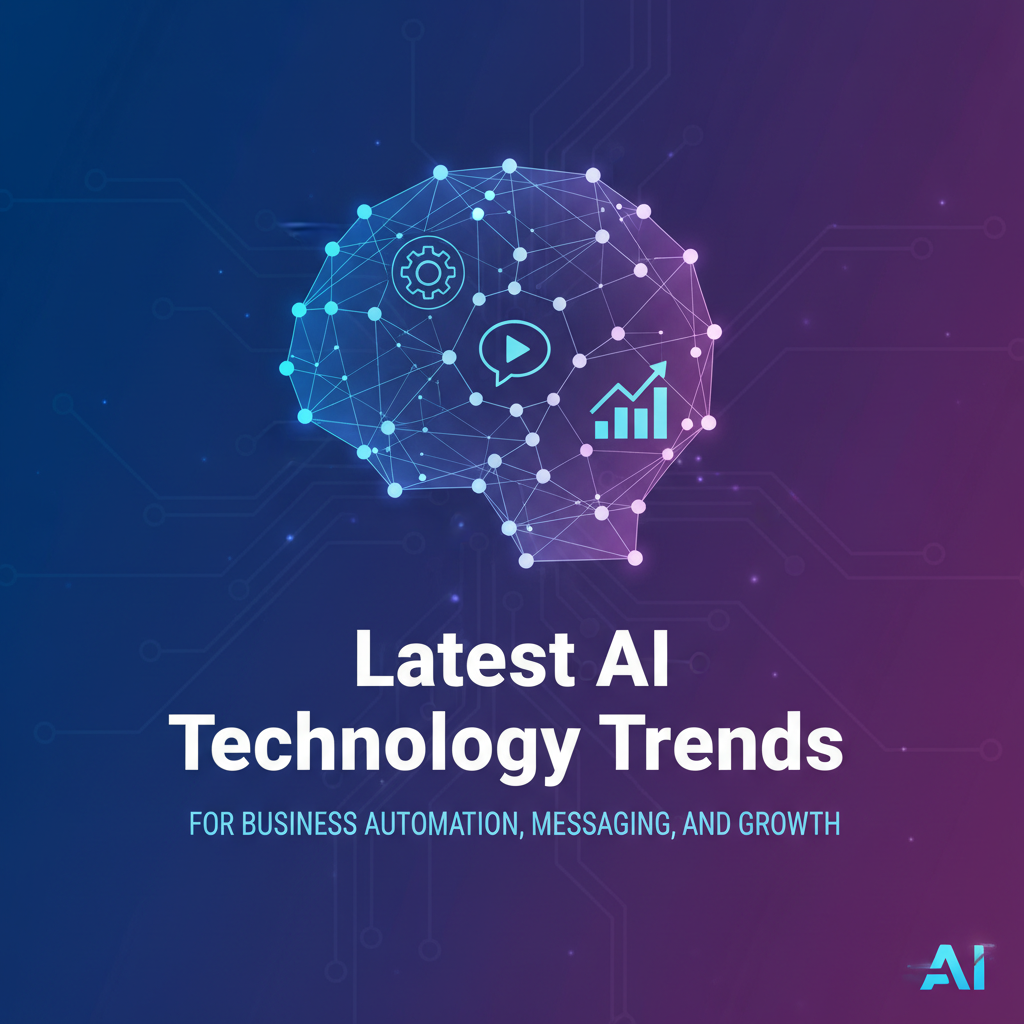
AI technology is moving from experimentation to measurable business impact—especially in customer communication, lead generation, and sales automation. This article breaks down the latest AI trends and shows how to apply them with practical workflows that reduce costs and accelerate revenue.
AI technology is no longer just a competitive advantage for large enterprises—it’s quickly becoming the default way modern businesses operate. The biggest shift in the last year is that AI has moved from “chatbots and pilots” to production-grade automation that can handle real customer conversations, qualify leads, schedule bookings, and support sales teams across multiple channels.
At the same time, customers have changed how they buy. They message first, expect instant replies, and compare options quickly. That’s why the most valuable AI trends today are the ones that connect intelligence to action: understanding intent, retrieving accurate information, automating next steps, and logging outcomes into your business systems.
Below are the latest AI technology trends shaping business automation, along with actionable ways to use them for customer communication, lead generation, and revenue growth.
One of the strongest trends is the rise of “AI employees”—AI agents designed to handle end-to-end operational tasks rather than just answering FAQs. Instead of a bot that only responds, an AI employee can guide a customer toward a goal: booking an appointment, placing an order, requesting a quote, or handing off to a human at the right moment.
This matters because responsiveness is revenue. If a lead messages your business on Instagram or WhatsApp at night and you respond the next morning, you often lose them to a competitor who answered immediately. AI employees solve that gap by maintaining consistent service quality around the clock.
Platforms like Staffono.ai are built specifically for this operational reality: providing 24/7 AI employees that can manage customer communication, bookings, and sales workflows across WhatsApp, Instagram, Telegram, Facebook Messenger, and web chat—without forcing customers to change channels.
Many businesses still design chatbot flows like a help center. Instead, build a conversation that aims for a business outcome.
An AI employee can run this flow consistently and instantly, while escalating edge cases to your team.
As businesses adopt generative AI, one concern remains: accuracy. The trend addressing this is Retrieval-Augmented Generation (RAG), where the AI retrieves information from approved sources (your knowledge base, policies, product catalog, pricing sheets) and uses that to generate responses.
RAG reduces hallucinations and makes AI much more suitable for customer-facing work—especially when you need the AI to reflect your latest offers, service terms, or inventory status.
To benefit from RAG, organize your customer-facing knowledge:
When your AI employee is grounded in this information, every conversation becomes more reliable—and easier to scale. In practice, businesses using Staffono.ai can keep messaging consistent across channels by centralizing how the AI responds to common questions and sales objections.
Websites still matter, but messaging is increasingly the first point of contact. Customers want to ask questions where they already spend time—WhatsApp, Instagram DMs, Telegram, Facebook Messenger, and embedded web chat.
The trend is not just being present on many channels; it’s providing a unified, consistent experience across them. AI enables that by handling repetitive conversations and ensuring that leads don’t slip through the cracks.
Imagine a local clinic or salon running Instagram ads. The most common failure point is delayed response. An AI employee can:
This is exactly the kind of cross-channel workflow that platforms like Staffono.ai are designed to automate—turning messaging into a predictable acquisition and booking system.
Not every lead is the right lead. The latest AI systems can qualify leads during the conversation by identifying intent, urgency, budget signals, and fit. This allows businesses to prioritize human time where it matters most.
Before implementing AI lead qualification, decide what “qualified” means for your business.
Once defined, your AI employee can apply the same criteria consistently, route high-intent leads to sales, and nurture lower-intent leads with follow-ups.
The biggest value comes when AI doesn’t stop at conversation. Modern AI automation connects messaging to workflows: creating bookings, sending confirmations, updating CRM records, and triggering follow-ups. This is where AI becomes operational infrastructure, not just a support layer.
A service business (renovation, logistics, legal, consulting) can automate the early sales cycle:
With a platform like Staffono.ai, these workflows can run 24/7 across the channels your customers prefer, reducing missed opportunities and improving conversion speed.
Customers expect relevant responses, not generic scripts. The trend here is AI that adapts tone, recommendations, and next steps based on context—while staying within your brand guidelines. Done well, this feels like high-touch service at low marginal cost.
Instead of trying to personalize everything, focus on a few high-impact areas:
Even simple personalization—like remembering what service the customer asked about—can dramatically improve conversions.
As AI handles more customer interactions, businesses must manage privacy, data security, and brand risk. Customers need correct information, clear escalation to humans when necessary, and consistent handling of sensitive topics.
Trust is not only about avoiding mistakes; it’s about delivering a reliable experience every time.
If you want practical progress (not just reading about trends), focus on one revenue-linked workflow and automate it end-to-end.
This approach ensures AI improves your business metrics: response time, booking rate, lead-to-sale conversion, and customer satisfaction.
The latest AI technology trends are clear: omnichannel messaging, accurate knowledge-grounded responses, real-time lead qualification, and workflow automation that drives measurable outcomes. The businesses that win won’t be the ones who “use AI,” but the ones who operationalize it.
If you want to implement 24/7 customer communication, automate bookings, and convert more leads across WhatsApp, Instagram, Telegram, Facebook Messenger, and web chat, explore Staffono.ai. Staffono’s AI employees are designed to help you scale conversations into conversions—without adding headcount and without sacrificing customer experience.