
AI headlines move faster than most product cycles, but customers judge you on reliability, not novelty. This article shows how to translate AI news and trends into practical build decisions, with concrete patterns for evaluation, rollout, and messaging automation that actually works.
AI technology is advancing at a pace that makes last quarter feel like last year. New model families, multimodal capabilities, open-source releases, agent frameworks, and tooling for retrieval and evaluation show up weekly. For builders and operators, the real challenge is not learning what is new, it is deciding what is safe, useful, and worth integrating without breaking customer trust.
This is where a mindset shift helps: treat AI as a “freshness” problem. You want your product to benefit from new capabilities quickly, but you also need stable behavior, measurable outcomes, and clear boundaries. In practice, that means building a system that can absorb change: new models, new prompts, new tools, and new data sources, while still producing consistent business results.
Instead of chasing every announcement, watch for trendlines that change what is feasible in production. Several are shaping how teams build reliable AI features today.
Models that can understand text plus images (and increasingly audio) change the kinds of workflows you can automate. For example, a customer can send a screenshot of a product, a photo of a damaged item, or a menu image, and your system can respond intelligently. The product opportunity is big, but so is the need for guardrails: image understanding can be wrong, and you must design escalation paths.
Not every task needs the largest model. Teams are increasingly mixing models: a smaller, cheaper model for classification, routing, and templated replies, and a more capable model for complex reasoning or nuanced customer interactions. This “model portfolio” approach can reduce cost and improve latency without sacrificing quality.
Agents that call tools (search, databases, CRMs, calendars, payments) can complete tasks end-to-end. The key shift: success depends less on clever prompting and more on workflow design, permissions, and observability. Agents fail in predictable ways when tools return unexpected data or when instructions conflict with policy.
The industry is moving from “it sounds good” to “prove it works.” Teams are adopting automated evals, regression test sets for prompts, and production monitoring for hallucinations, refusals, and customer satisfaction. If you want to ship AI that customers trust, evaluation is not optional.
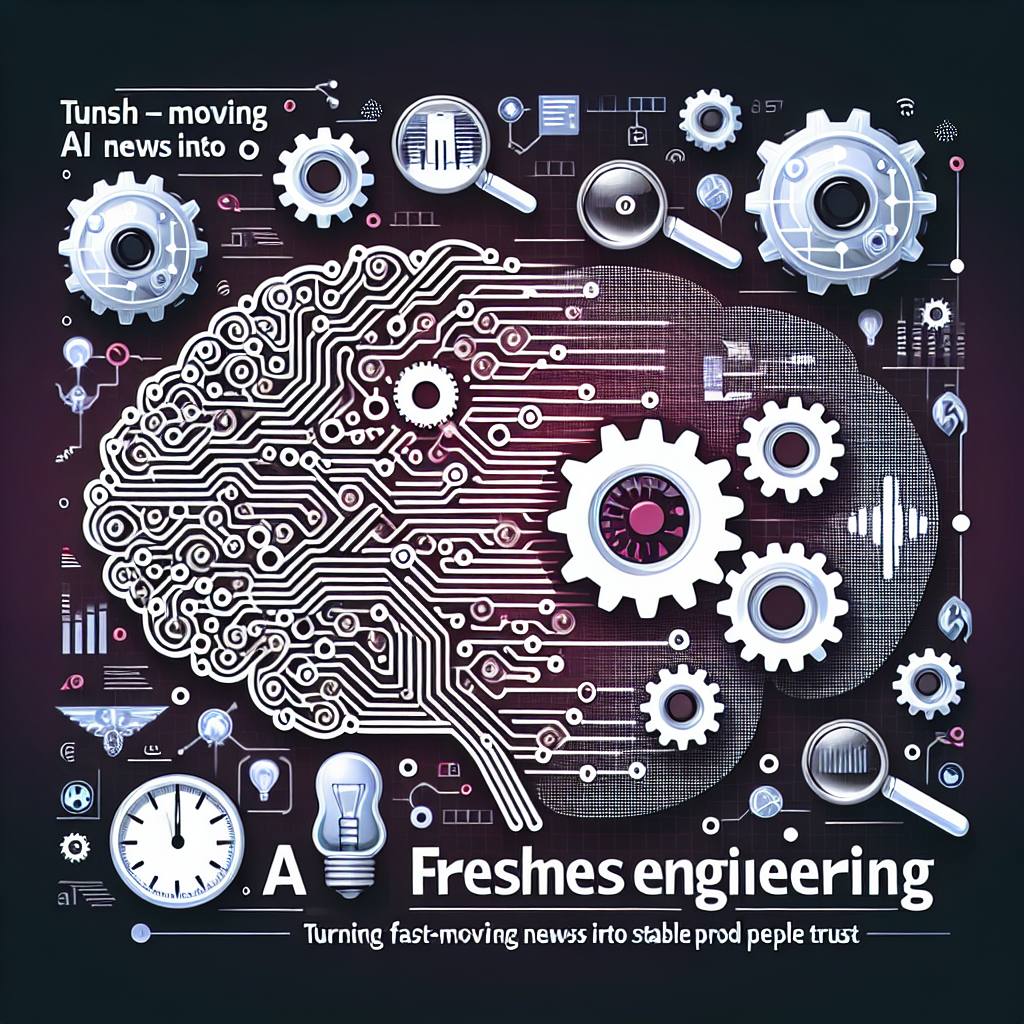
Freshness Engineering is a practical approach to integrating new AI capabilities without destabilizing your product. Think of it as an operating rhythm: detect changes, test them, release safely, and learn continuously.
Create a lightweight intake system for AI news. The goal is not to read everything, it is to classify updates by relevance to your workflows.
Assign each signal a simple tag: “experiment,” “pilot,” “ignore,” or “urgent.” Urgent signals are usually deprecations or security related changes, not flashy demos.
A useful habit is to turn each interesting update into a hypothesis tied to a business metric. Example: “If we use structured outputs for checkout questions, we can reduce handoffs to human agents by 15%.” This forces clarity about what you will measure and where it fits in your system.
Before you swap models or prompts in production, run evaluations that reflect your real workload. Do not rely on generic benchmarks. Build a small but representative test set from your conversations, tickets, or leads.
Include at least four categories:
Score outputs with a mix of automation and human review. Automation can check JSON validity, required fields, and policy keywords. Humans should sample for tone, correctness, and whether the answer would create operational risk.
Once you accept that models will change, you design for resilience. These patterns help you ship improvements without surprise regressions.
Use a small, fast model to route requests into categories (sales, support, booking, escalation), then send each category to a specialist prompt or workflow. This reduces variability and makes testing easier because each specialist has a narrower scope.
Example: A customer writes, “Can I book for Saturday and also ask about refunds?” The router can split intent into booking plus policy, then run two workflows: one that checks availability and one that returns your refund rules with the correct conditions.
When AI needs to update systems, insist on structured output. Instead of “I can book you at 3 pm,” require a payload like: date, time window, service type, customer name, channel, and confidence. Your application can validate fields before calling a calendar API.
This reduces failures and makes monitoring straightforward because you can track how often fields are missing.
Guardrails are not only about blocking unsafe content. They also include business constraints: pricing rules, service areas, opening hours, and availability. When the system is uncertain, it should ask a clarifying question or hand off to a human.
Platforms like Staffono.ai are built around this reality in messaging: the AI employee can handle routine conversations across WhatsApp, Instagram, Telegram, Facebook Messenger, and web chat, and still escalate when confidence is low or when a request requires approval. Designing escalation as a feature, not a failure, is what preserves trust.
When you adopt a new model, do not flip a switch for everyone. Run it in shadow mode first: generate responses but do not send them, then compare with your current system. This helps you catch regressions in tone, policy compliance, and correctness before customers see them.
After shadow mode, roll out to a small percentage of traffic, monitor metrics, and only then expand.
Here are practical ways to use current AI trends without overengineering.
Many businesses lose conversions in messaging because scheduling takes too long. Build a workflow that:
Staffono.ai fits naturally here because it already operates as an always-on AI employee across the channels where customers actually book. Instead of adding a chatbot that only works on your website, you can automate bookings where demand already arrives.
AI can qualify leads by asking a short sequence of questions and storing answers in your CRM. Keep it polite and brief. Focus on constraints that determine fit: budget range, timeline, location, and key requirements.
To keep quality high, define “qualification exit rules” such as: if budget is below minimum, offer an alternative plan; if timeline is urgent, prioritize human follow-up; if requirements are unclear, ask for a voice note or a photo.
Customers do not only want information, they want resolution. Pair answers with next actions: a link, a form, a booking slot, a return label request, or an escalation. This reduces repeat messages and improves satisfaction.
In Staffono, you can set up automation that answers common questions, collects order details, and routes complex cases to a human teammate, keeping the conversation context intact across WhatsApp and web chat.
If you cannot measure it, you cannot safely increase freshness. Track metrics that reflect both business outcomes and customer trust.
Pair metrics with a weekly review of a small conversation sample. This creates a feedback loop where prompts, routing rules, and knowledge sources improve steadily.
Freshness Engineering works when you adopt a few principles:
AI technology will keep accelerating, but customers will keep rewarding the same thing: consistent experiences. The teams that win are the ones that can adopt new capabilities quickly without turning every update into a fire drill.
If your goal is to put these ideas into production in customer messaging, Staffono.ai (https://staffono.ai) is a practical starting point: an AI-powered automation platform with 24/7 AI employees that can handle conversations, bookings, and sales across WhatsApp, Instagram, Telegram, Facebook Messenger, and web chat. When you are ready to move from experiments to dependable operations, using Staffono to deploy, monitor, and refine real workflows can help you capture the upside of AI news while keeping your product stable.